
The Moon Is Becoming Supply-Chain Infrastructure, Not a Research Outpost
An executive order redrew the U.S. defense perimeter out to the Moon. China's Chang'e-7 is already headed for the same real estate. Here's how a tracking blind spot, a coalition split and a scrapped space station all point to the same conclusion.
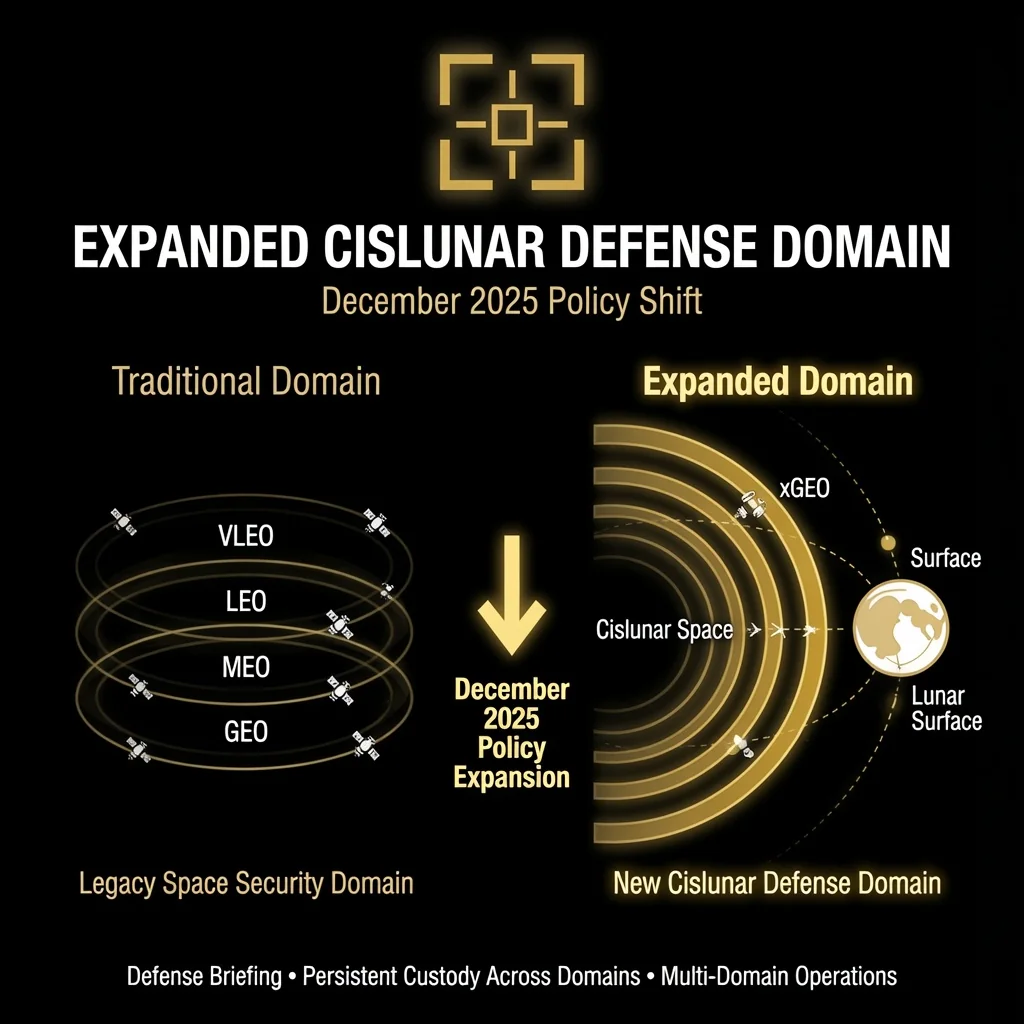
A December 2025 executive order redefined the U.S. military's space responsibilities from very low Earth orbit through cislunar space, formally extending the defense perimeter to the Moon. Graphic: Defense Briefing.
The era of lunar exploration driven by scientific curiosity alone has ended. Researchers will still work in cislunar space, in greater numbers than ever, in fact. But heading into the second half of the 2020s, the strategic stakes have grown too large for science to remain the sole focus.
The Pentagon has made Offensive Space Control a newest operational priority. Defense officials are not describing an imminent "Star Wars" scenario, but they are explicitly signaling that cislunar space, the vast region stretching from Earth orbit to the Moon, is now core to military planning. U.S. Space Command (SPACECOM) has elevated both cislunar and xGEO (extended geosynchronous orbit, the transitional layer preceding cislunar space) to a top science-and-technology priority for fiscal year 2028 and beyond, marking a shift from passive monitoring to active operational preparation.1 The open question: will rivals wait for the United States to get there first?
Welcome to Orbital Intel, presented by Defense Briefing. Every Wednesday, you receive the week's defense, aerospace and space economy signal in plain language. Primary sources. No hype. Built for analysts, operators and the curious.
Today's headlines are rarely new. They're sequels. We deliver the prequels.
CISLUNAR SPACE IN 30 SECONDS
- • The region between Earth orbit and the Moon, 1,728 times the volume of geosynchronous orbit
- • Newly designated U.S. defense territory under a December 2025 executive order
- • Tracked poorly today; ground radar and near-Earth sensors can't reliably watch it
- • The lunar south pole is the contested prize: water ice, sunlight, and usable terrain
- • China's Chang'e-7 and NASA's Moon Base program are both racing there in 2026
Understanding Cislunar Space: The New High Ground
Cislunar space is the volumetric region encompassing Earth, the Moon, and the gravitational pathways between them, extending far beyond geosynchronous orbit (GEO). Where low Earth orbit (LEO) sits just above the atmosphere and GEO hosts most military and commercial communications satellites, cislunar space is vastly larger and far less familiar to traditional space operators. An Air Force Research Laboratory (AFRL) fact sheet puts its volume at 1,728 times that of GEO.2
To manage that expanse, the Space Force established a Cislunar Coordination Office in April 2026, led by Jaime Stearns, a former AFRL program manager who most recently led strategic communications at the Space Rapid Capabilities Office. The office's mandate is geographic, not speculative: when human and commercial activity enters new territory, surveillance, logistics and security infrastructure inevitably follow. In cislunar space, the first military problem isn't kinetic engagement. It's simply knowing what's out there.
The Blind Spot: America's Tracking Vulnerability
U.S. orbital awareness degrades sharply the farther an object travels from Earth. The Pentagon's current tracking architecture is built for near-Earth requirements: missile warning, hypersonic tracking, tactical communication in LEO. Cislunar objects are thousands of times farther away, rendering ground-based radar largely obsolete, and they don't follow simple orbital tracks. Three-body physics governs motion influenced by both Earth and the Moon. Spot-checking an object once and calculating a stable path doesn't work here; the requirement is "custody," continuous tracking over time.
Stearns previously commanded AFRL's Oracle project, which is fielding cislunar domain-awareness satellites over the next several years specifically to close this gap.2 The stakes are real: a rogue or unverified spacecraft that slips through cislunar space undetected could reposition to threaten Earth-orbit assets, jam communications, or disrupt future lunar logistics nodes. Arriving late to this domain lets adversaries make opening moves before the U.S. can establish presence.
Want this kind of defense and space intelligence every Wednesday?
Get Orbital Intel FreeThe Policy Shift: Space Superiority as Doctrine
An executive order on American space superiority, signed 18-DEC-2025, mandates that U.S. defense agencies detect, characterize and counter threats to American space interests from very low Earth orbit through cislunar space, explicitly including the risk of nuclear weapons placement in deep space.3 That order gives strategic cover for what SPACECOM's technical roadmaps already demand: autonomous orbital mobility, in-space refueling, cislunar navigation beacons, resilient deep-space communications and integrated battle management software.
Policy signals intent; appropriated budgets and signed contracts are proof. Cislunar systems are now entering the defense procurement queue, and the real indicator of readiness will be which specific programs land dedicated funding lines in successive National Defense Authorization Acts (NDAAs). A policy memo doesn't militarize the Moon. Hardware acquisition does.
A Cislunar "Cold War," But Not a Blockade
This is the foundation of a modern space Cold War: parallel, non-interoperable logistics networks competing for position. The obvious question, can the United States simply prevent China and its coalition from reaching or operating on the Moon, has a definitive answer: no. The physical scale of cislunar space makes a literal blockade impossible, and the 1967 Outer Space Treaty, to which the U.S., Russia and China are all signatories, explicitly bars national appropriation of celestial bodies while guaranteeing free access to space.
So the competition won't look like a naval blockade. It will look like a race for choke-point custody: establishing dominant surveillance, communications relays and landing-zone infrastructure to out-maneuver rivals and drive up their operational costs, without ever physically blocking a launch.
Why the Lunar South Pole Is the Prize
The lunar south pole has become the focal point of this competition because it combines three logistical advantages: accessible water ice, sustained solar illumination along elevated crater rims, and tightly constrained terrain that concentrates activity into a small number of usable sites.
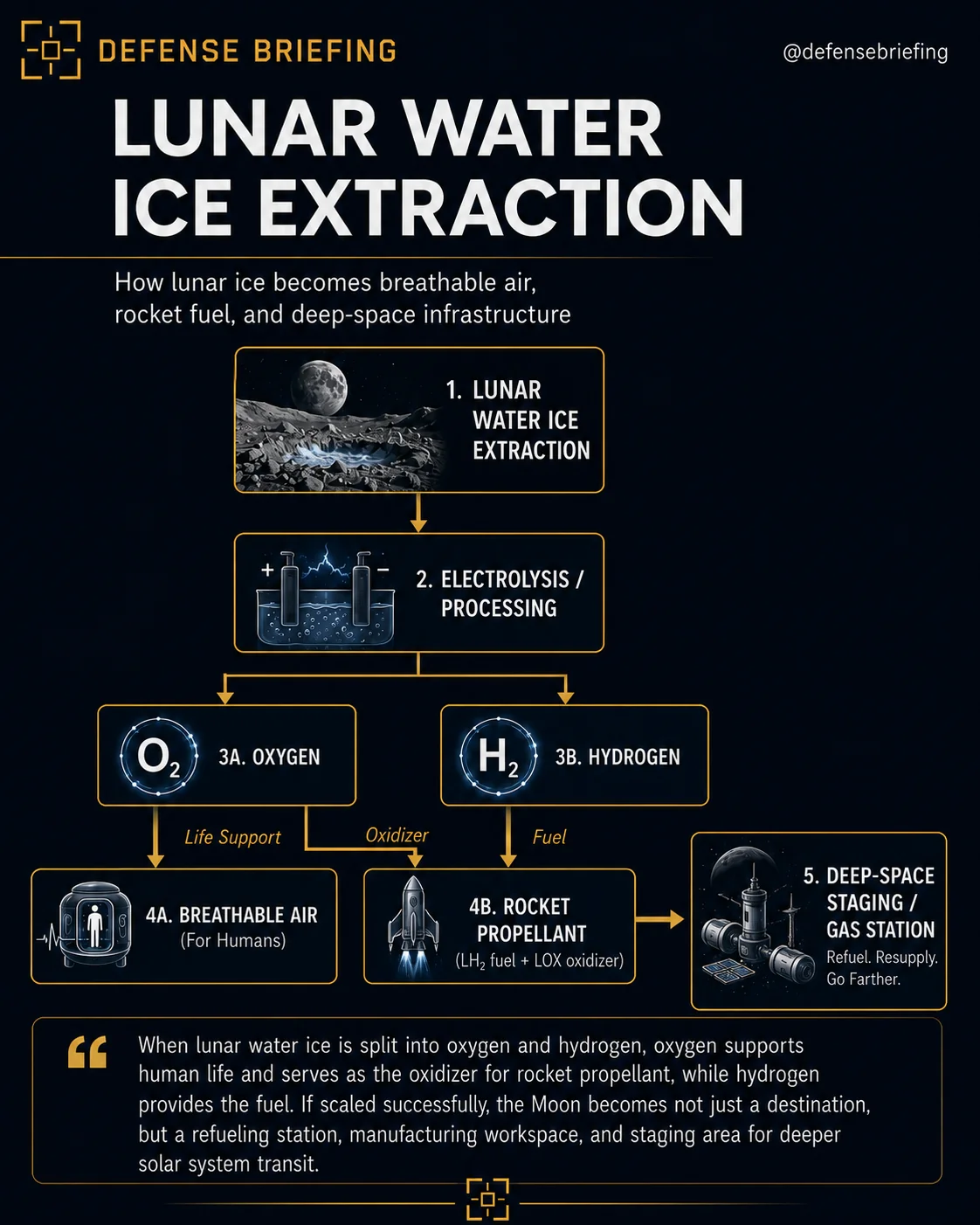
NASA's In-Situ Resource Utilization (ISRU) research is built on one core idea: lunar water ice can become breathable air and rocket propellant without hauling either from Earth. Graphic: Defense Briefing using NASA ISRU data.
NASA data shows water ice trapped in permanently shadowed craters can support breathable air, drinking water and, through electrolysis, liquid hydrogen and oxygen propellant. That capability eliminates the need to haul every unit of life-support and fuel mass out of Earth's gravity well, which is the entire premise behind NASA's In-Situ Resource Utilization (ISRU) investments. If ISRU scales successfully, the Moon shifts from a destination to a refueling station, manufacturing site and staging area for deeper solar system transit.
That reshapes the supply chain question entirely. On the lunar surface, choke points are defined by a short list: landing sites, power generation zones, navigation beacons, communications arrays, surface mobility vehicles, excavation equipment, cryogenic storage and ascent vehicles. Whoever sets the operating standards for that short list, not whoever publishes the most research, holds the leverage.
China's Chang'e-7 Makes the Timeline Concrete
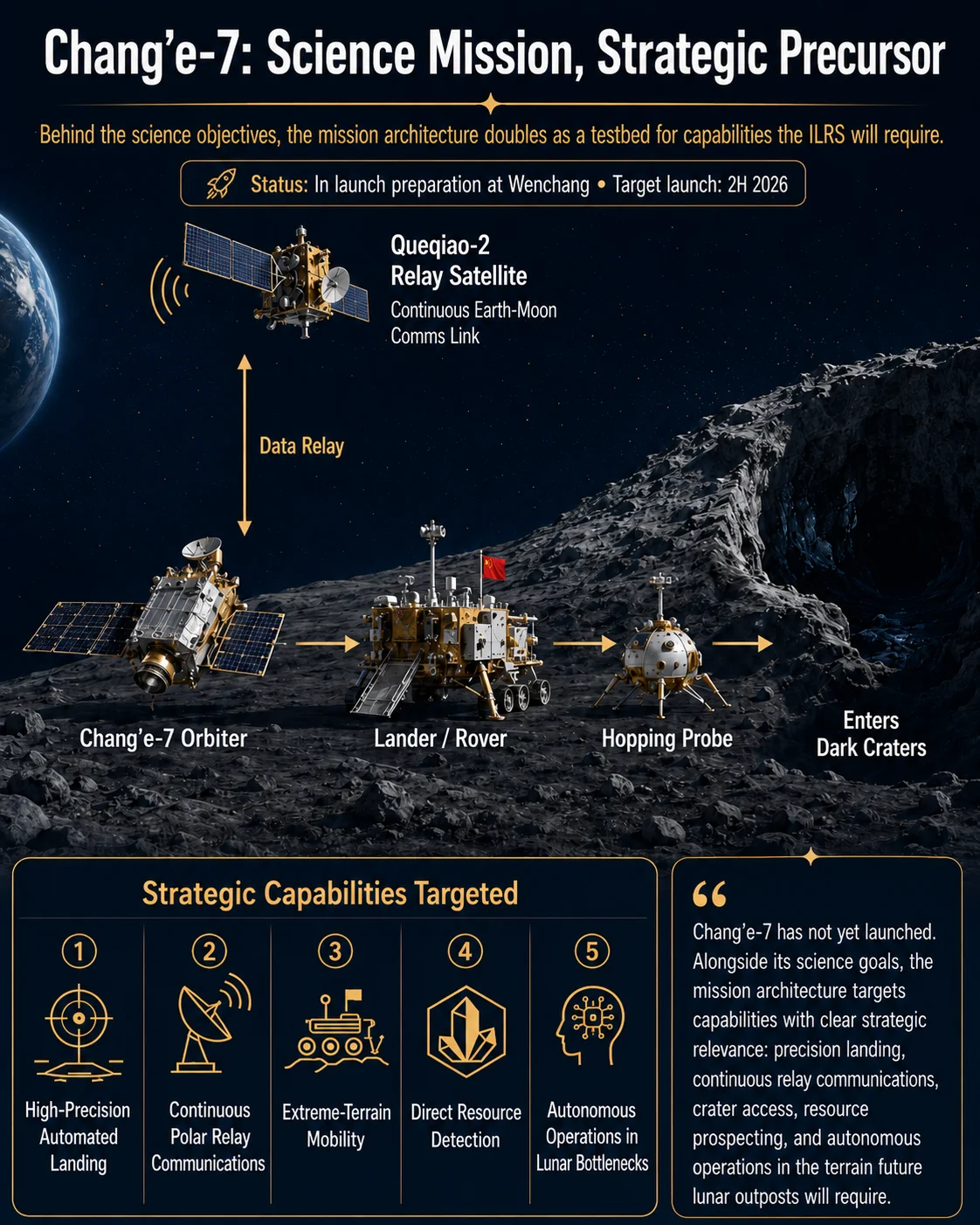
Chang'e-7 is in launch preparation at Wenchang, targeting the second half of 2026. Its hopping probe is built to enter permanently shadowed craters no rover can reach. Graphic: Defense Briefing using CNSA and Planetary Society data.
Beijing's Chang'e-7 mission, targeting launch in the second half of 2026, is aimed directly at the lunar south pole. Per the Planetary Society's mission brief, it's a multi-vehicle water-hunting deployment: an orbiter, a lander, a rover and an autonomous hopping probe, all supported by the already-operational Queqiao-2 relay satellite.4 The hopping probe is the notable piece. It's built to rocket-hop into permanently shadowed craters where conventional rovers would fail, and drill there to confirm water ice concentration and depth.
"Western analysts shouldn't claim China has won the south pole, but Beijing is methodically mapping terrain and banking operational experience well ahead of anyone's crewed timeline."
Behind its science objectives, the mission architecture doubles as a testbed for capabilities any future outpost will require: precision landing, continuous polar relay communications, extreme-terrain mobility, direct resource detection and autonomous operation in the exact terrain bottlenecks a permanent presence will have to navigate.
Two Blocs, One Moon
This isn't a bilateral rerun of the 1960s. The West operates under the Artemis Accords: as of 25-JUN-2026, the State Department and NASA confirmed Botswana as the 68th signatory, binding participants to transparency, peaceful exploration, open data sharing and cooperative "safety zones."5
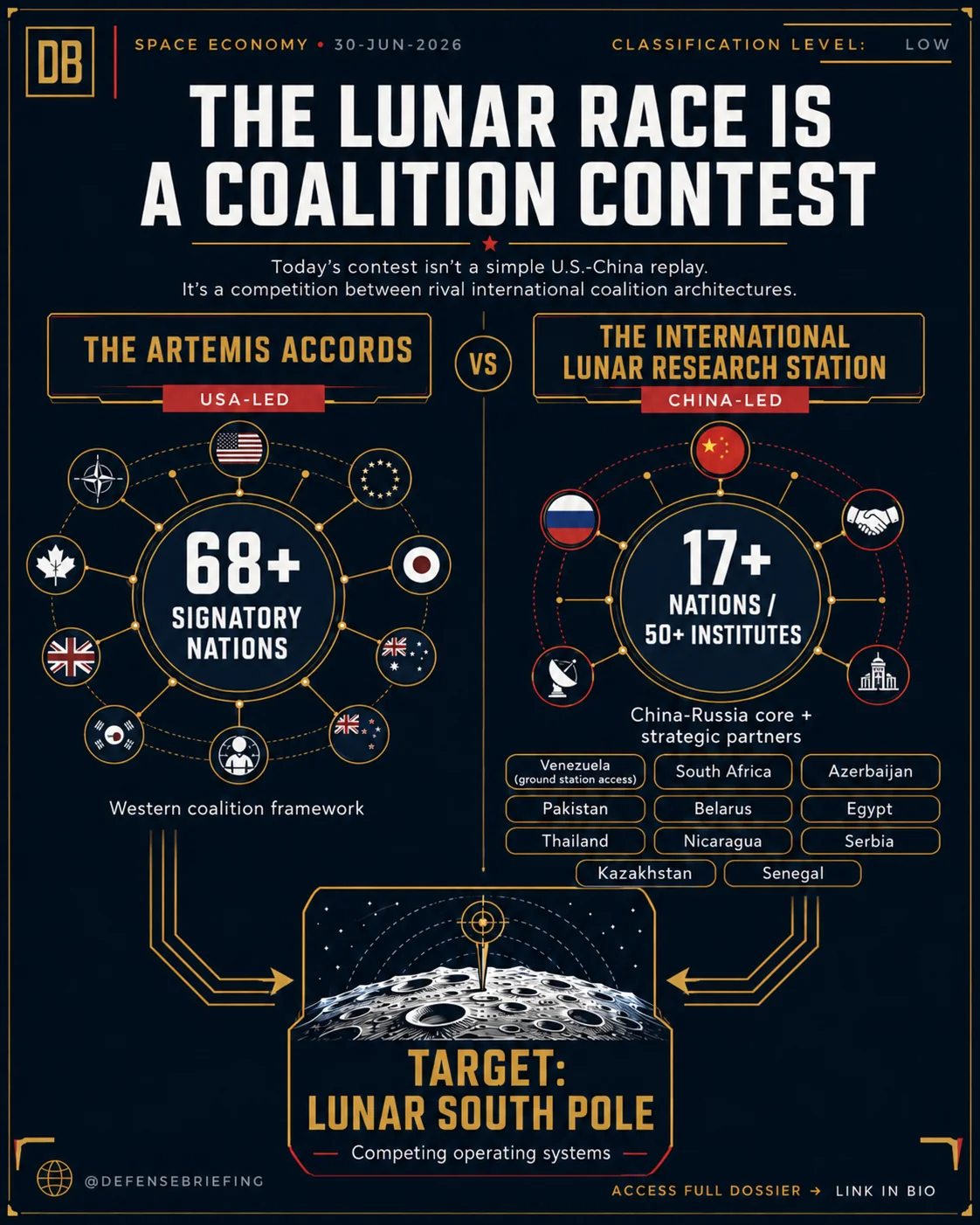
Two coalition architectures, two rule sets, one target: the lunar south pole. Graphic: Defense Briefing using U.S. Department of State and CNSA data.
Beijing's parallel architecture, the International Lunar Research Station (ILRS), is smaller but growing quickly. Beyond the China-Russia core, the China National Space Administration (CNSA) has signed national-level partners including Venezuela, which also grants ground station access, South Africa, Azerbaijan, Pakistan, Belarus, Egypt, Thailand, Nicaragua, Serbia, Kazakhstan and Senegal: 13 sovereign nations in total. Add organizations like the Asia-Pacific Space Cooperation Organization and CNSA's own count reaches "17+ countries and organizations, and more than 50 research institutions," the figure Beijing itself has cited most recently.6
For many Global South states, ILRS is a lower-barrier entry into lunar exploration: tech transfers, co-development roles and a sovereign-friendly alternative to Western frameworks, with China positioned as senior partner. Two entirely different rule sets, engineering standards, data-sharing protocols, commercial access, are being installed across the same physical geography at the same time.
Get the full source trail behind every figure in this transmission.
Subscribe FreeNASA's Commercial Bet
The American counter to a state-run challenge is domestic industrial capacity. NASA's Commercial Lunar Payload Services (CLPS) program buys delivery services from private firms rather than building hardware in-house. The agency currently has 13 vendors under contract, has awarded 11 delivery task orders covering more than 60 instruments, and operates under a $2.6 billion ceiling through 2028, though NASA has signaled it intends to raise that ceiling to $4.2 billion, a move worth tracking given what it would say about program confidence and cadence.7
That commercial bet got a structural upgrade in March 2026, when NASA paused the Lunar Gateway, the orbital space station long billed as Artemis's central pillar, in its current form, redirecting funding toward a phased "Moon Base" surface strategy instead.8 NASA reached its first concrete milestone under that pivot in May 2026, awarding three task orders.
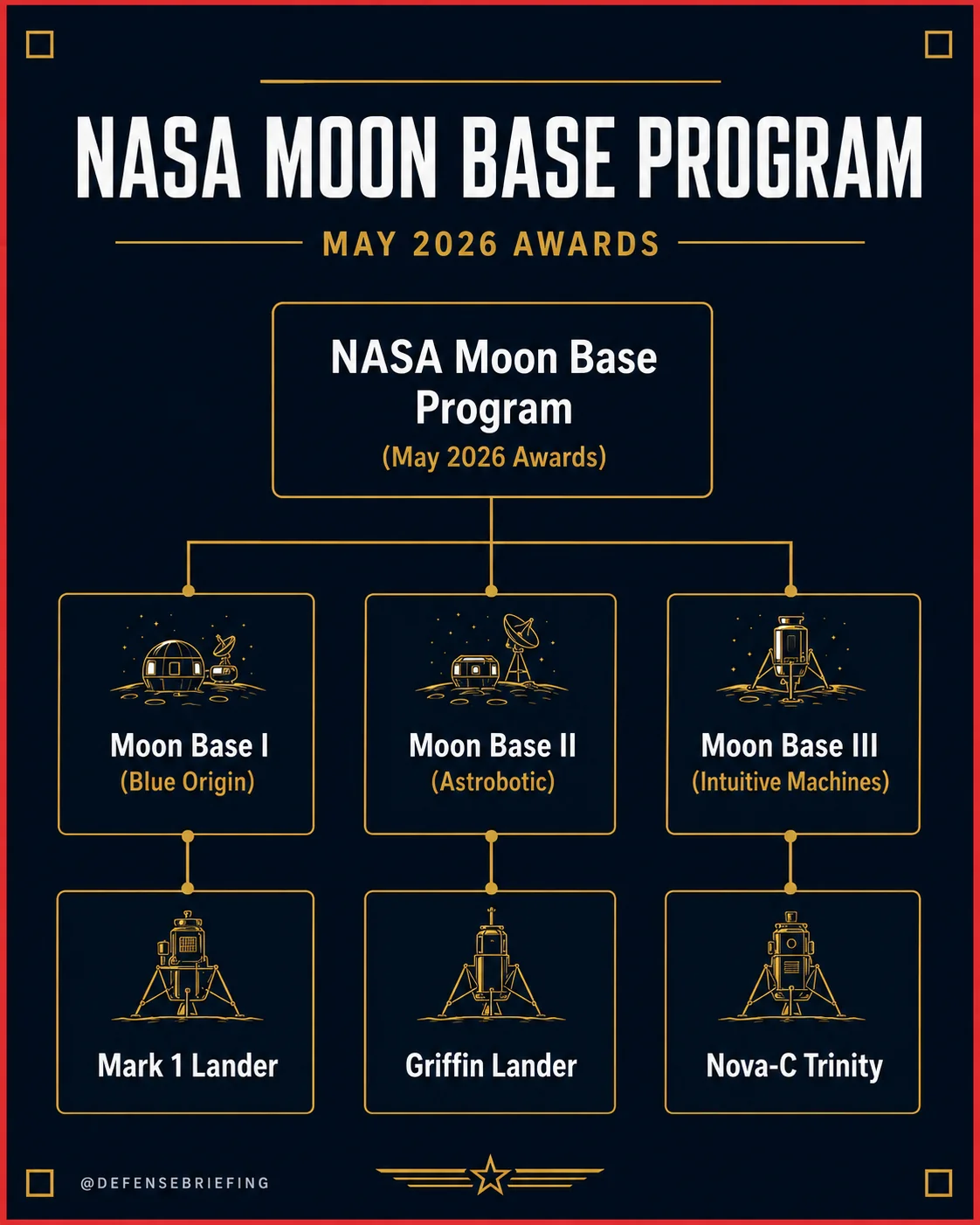
NASA's first three Moon Base task orders, awarded 26-MAY-2026, mark the pivot from an orbital way station to hardware that lands directly on the lunar surface. Graphic: Defense Briefing using NASA and Senate Commerce Committee data.
Moon Base I went to Blue Origin's Blue Moon Mark 1 Endurance lander, targeting the Shackleton Connecting Ridge. Moon Base II went to Astrobotic's Griffin lander, carrying over 1,100 pounds of cargo including Astrolab's FLIP rover. Moon Base III went to Intuitive Machines' Nova-C Trinity lander, carrying the Lunar Vertex magnetic anomaly investigation.8
The message is direct: NASA decided an orbital way-station wasn't required to hit its near-term objectives, and reallocated toward hardware that lands directly on the choke points that matter. It's the same structural pattern used in LEO: government defines the mission, commercial industry builds and operates the transport layer, with the same tradeoff. Speed and cost efficiency, purchased at the price of dependence on private execution.
The Supply Chain Map: Six Layers
A permanent lunar base is an integrated chain of solved logistics problems, not a self-contained structure. Six codependent layers make it up:
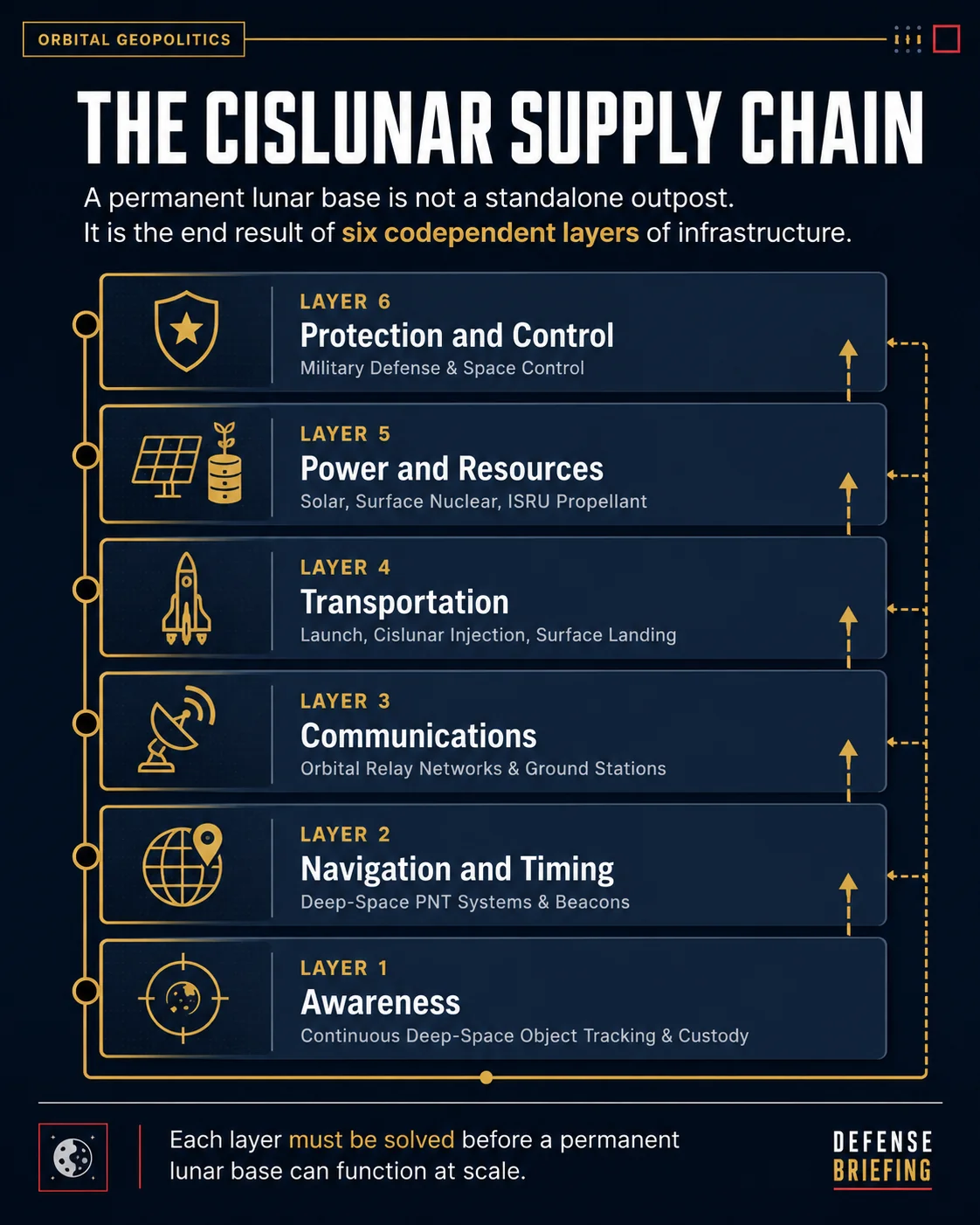
Each layer must be solved before a permanent lunar base can function at scale, and each will produce its own set of strategically indispensable firms. Graphic: Defense Briefing.
- Awareness: tracking assets beyond GEO, maintaining custody of maneuvering vehicles, reading foreign intent.
- Navigation and Timing: GPS is useless at lunar distances; cislunar operations need an independent positioning, navigation and timing (PNT) network.
- Communications: a resilient, high-bandwidth relay linking surface assets, orbiters, landers and Earth.
- Physical Transit: heavy-lift launch, trans-lunar injection, orbital insertion, precision landing, surface cargo movement, ascent and return.
- The Industrial Engine: solar arrays, surface reactors, water-ice extraction, oxygen processing, cryogenic storage.
- Protection and Control: the explicit military layer: defending infrastructure, denying interference, training for space-control contingencies.
Every layer represents billions in procurement and its own set of technical choke points, and each will produce the specialized firms and state entities that become strategically indispensable.
What to Watch Next
- SPACECOM budget allocations: whether FY2028 appropriations actually fund cislunar domain awareness at the level SPACECOM has prioritized, or whether it stays a stated priority without a funding line.
- Cislunar Coordination Office roadmaps: the office's first published technology roadmap will show whether it's setting real acquisition timelines or just organizing existing programs.
- AFRL Oracle deployments: Oracle Prime's planned 2027 launch to the Earth-Moon L1 Lagrange point is the first real test of custody-grade tracking beyond GEO.
- Chang'e-7 execution: whether the hopping probe successfully confirms water ice concentration will determine how fast China moves toward Chang'e-8's resource-utilization tests.
- NASA Moon Base milestones: whether Moon Base I, II and III hit their fall/late-2026 launch windows, and whether the CLPS ceiling increase to $4.2 billion is finalized.
- Cislunar PNT and comms contracts: the first dedicated award for independent lunar-distance navigation will mark the shift from concept to acquisition.
- Coalition growth rates: how quickly the Artemis Accords and ILRS add signatories, and whether any nation signs onto both.
- ISRU technical feasibility: whether NASA's planned lab demonstration of oxygen production from icy regolith translates into a deployable system.
Metrics to ignore: astronaut landing dates and press-conference rhetoric. The real signal is cargo, communications arrays, tracking sensors, power grids and fuel storage actually being deployed.
The Angle
The Pentagon's near-Earth orbital mesh was the first visible layer of a modernized, wartime space architecture.9 A secure cislunar supply chain is the next one. The Moon becomes nationally relevant the moment it stops being a science destination and starts being infrastructure.
The 1960s space race ended when astronauts packed up their samples and came home. This one is different because the machines are built to stay. Planting a flag demonstrates arrival; securing a supply chain demonstrates control. If the United States wants to remain the dominant power beyond Earth orbit, rockets and rhetoric aren't enough. It needs deep-space sensors, communication relays, heavy landers, automated fuel production, surface power, cargo networks, and the military capability to protect all of it.
Forward this to the portfolio manager who still thinks the Moon is a science story.
Sources: Space Force Cislunar Coordination Office establishment and Air Force Research Laboratory Oracle program reporting; U.S. Space Command offensive cislunar exploration briefings; Executive Order 14369, "Ensuring American Space Superiority," signed 18-DEC-2025; The Planetary Society's Chang'e-7 mission profile and China National Space Administration briefings; U.S. Department of State Artemis Accords signatory records; NASA Commercial Lunar Payload Services program data and Moon Base task order announcements. No classified information was used and all material is publicly accessible.