
The Pentagon’s Orbital Mesh
The defense industry broke the prime monopoly on paper. Now it must prove that hundreds of satellites built by rival contractors can fight as one machine.
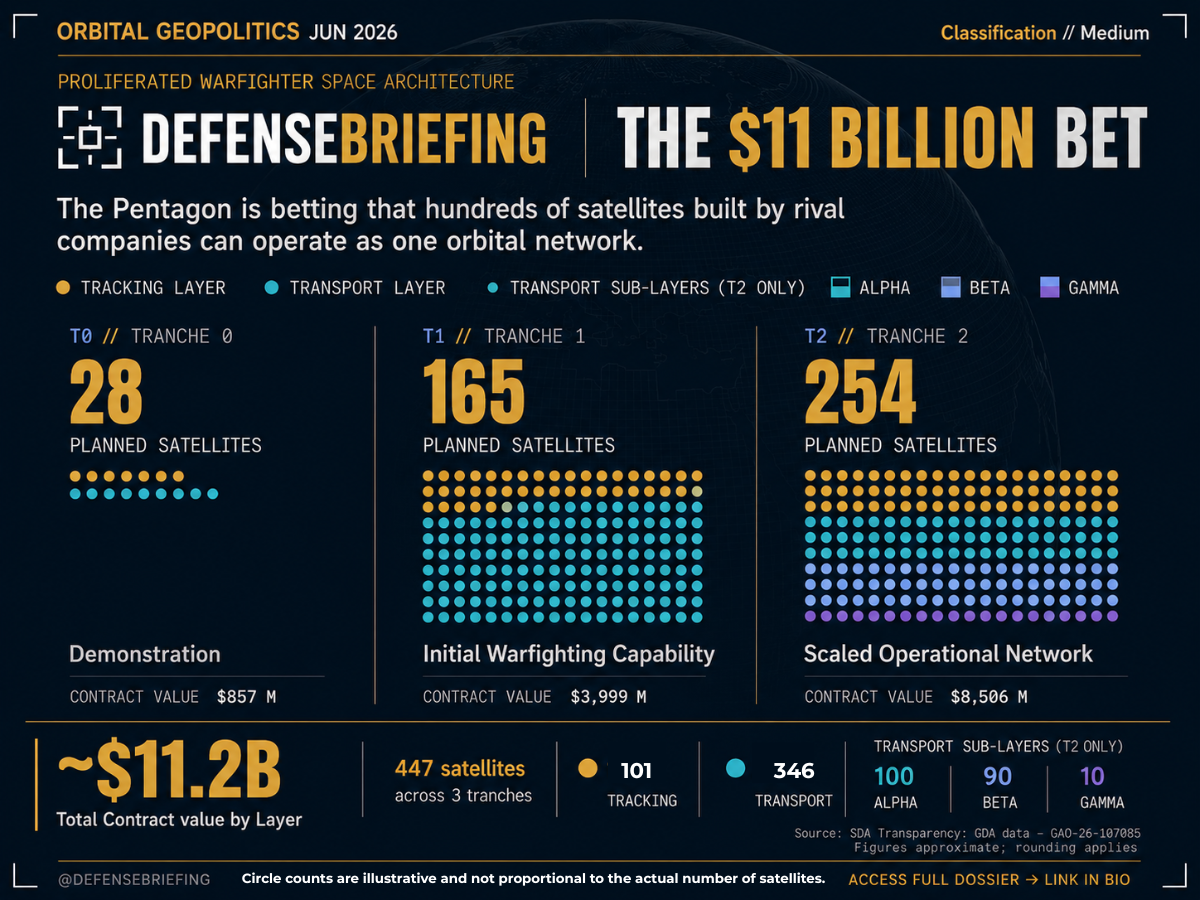
The Space Development Agency's proliferated architecture scales from demonstration satellites to hundreds of planned operational spacecraft. Graphic: Defense Briefing using GAO and SDA public data.
For three decades, the criticism of the United States defense industrial base was simple enough: a handful of massive defense conglomerates controlled every critical bottleneck.
The old model was born in the twilight of the Cold War. In 1993, senior Pentagon leaders gathered top defense executives at what became known as the “Last Supper,” a private dinner that sent a blunt message to the industry: consolidate or watch the shrinking post-Cold War budget slowly starve out your backlogs. The result was a defense sector that moved from dozens upon dozens of aerospace and defense firms to a handful of giants: Lockheed Martin, Raytheon, now RTX, Northrop Grumman, Boeing and General Dynamics. The Pentagon's own 2022 competition review highlighted the problem with hard numbers: tactical missile suppliers fell from 13 to three, fixed-wing aircraft suppliers from eight to three and satellite suppliers from eight to four.1
That consolidation created scale. It also created dependency.
The Space Development Agency (SDA) was created to move in the opposite direction. Instead of placing a limited number of exquisite satellites into orbit over many years, the agency would field smaller, cheaper satellites in low Earth orbit (LEO), with delivery and installation happening in rapid two-year blocks called tranches. Instead of relying on one protected prime contractor lane, it would force multiple vendors into the same architecture. Instead of waiting for perfection, it would launch, test, learn, upgrade and repeat.
That was the sales pitch anyway. The audit trail is rougher.
A February 2025 Government Accountability Office (GAO) report found that the SDA's demonstration tranche, known as Tranche 0, had not fully demonstrated the laser communications capability the larger architecture depends on. As of December 2024, one of four prime contractors had demonstrated three of eight planned laser communications capabilities. Another had demonstrated one. The other two had demonstrated none.2
The SDA does not accept that framing. In its formal response, the Pentagon told GAO that Tranche 0 met its minimum viable product, which it defined as demonstrating the feasibility of the proliferated architecture in cost, schedule and scalability. The Department of Defense (DoD) concurred with GAO's recommendations.
The hardware is in the air. The contracts are continually flowing. The mesh is still proving itself, one tranche at a time.
Welcome to Orbital Intel, presented by Defense Briefing. Every Wednesday, you receive the week's defense, aerospace and space economy signal in plain language. Primary sources. No hype. Built for analysts, operators and the curious.
Today's headlines are rarely new. They're sequels. We deliver the prequels.
The Architecture
The program at the center of this fight is the Proliferated Warfighter Space Architecture (PWSA). Its basic structure is easy to explain. The Transport Layer moves data. The Tracking Layer detects and tracks missile threats. Optical communications terminals (OCTs) connect satellites to each other via laser beam. The benefit is that optical communication is fast. Data can move across orbit without having to divert down to a ground station first, then be rerouted to its destination. It eliminates a step and speeds up the chain.
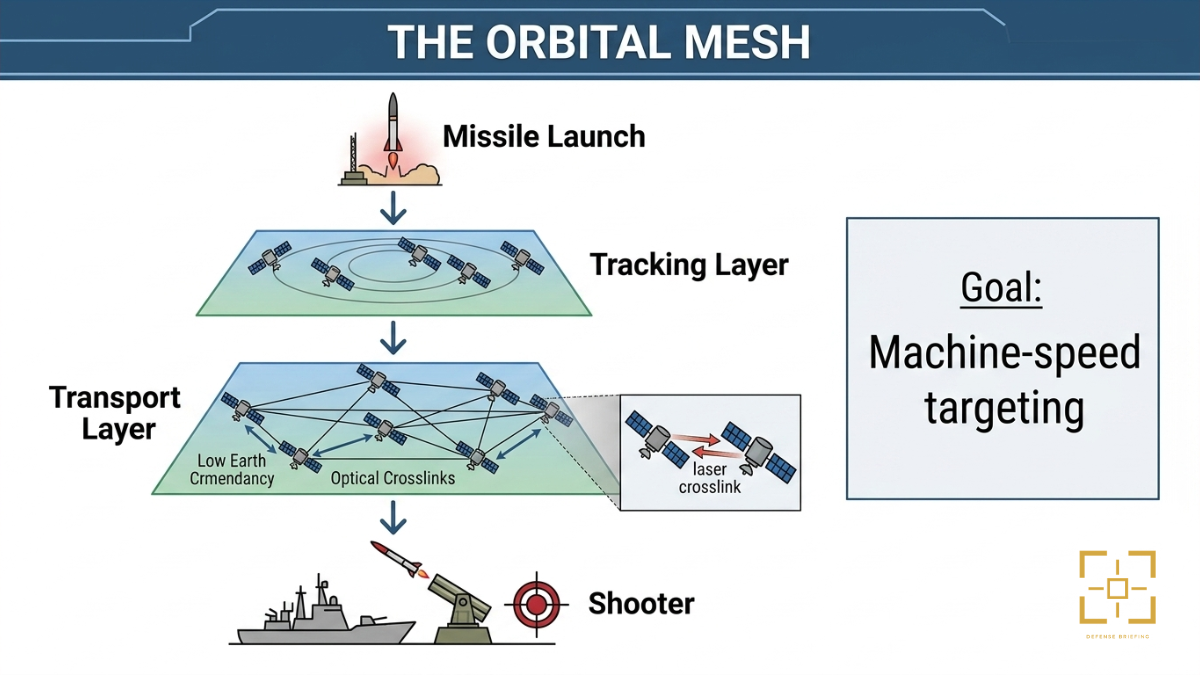
PWSA is designed to move missile-warning and targeting data through tracking satellites, transport satellites and optical crosslinks before reaching weapons systems. Graphic: Defense Briefing.
In theory, that gives the U.S. military a faster, more resilient network for missile warning, missile tracking, beyond-line-of-sight targeting and Joint All-Domain Command and Control (JADC2). In practical terms, the Pentagon wants an orbital internet of war. If a missile launch is detected in the Pacific, that data can route through the mesh to a missile defense station or a fighter jet in seconds, without human controllers manually bridging the gap, slashing the time it takes to confirm a threat and lock onto a target.
GAO described PWSA as a planned LEO architecture of at least 300 to 500 satellites. It reported that DoD had committed nearly $11 billion to the effort since 2020 and planned to spend nearly $35 billion in total through fiscal year 2029.3
Tranche 1 is supposed to be the first real warfighting layer. The SDA says it will consist of 154 operational space vehicles: 126 Transport Layer satellites and 28 Tracking Layer satellites, plus four missile-defense demonstration satellites. Those satellites carry optical communications terminals and Ka-band radio frequency (RF) capability. Beginning in 2027, the SDA says Tranche 1 is intended to provide initial warfighting capability.
That RF fallback is an essential piece. If the optical layer fails, degrades or is attacked, the constellation does not automatically go dark. It can still use RF pathways. But that is also the point: the leap forward is the laser mesh. If the optical layer does not perform, the architecture loses part of what made it ambitious in the first place.
The $10 Billion Gap
The SDA's model is called spiral development. Launch a tranche. Learn from it. Build the next one using the knowledge gained from the previous tranche. Repeat.
There is nothing reckless about that in principle. The old acquisition model was too slow. China and Russia are not waiting for the Pentagon to follow protocols. Hypersonic missiles, counterspace weapons, electronic warfare and cyber operations have already reshaped the battlefield, constantly adding new layers of potential attack. The problem is not that the SDA is moving fast. The problem is whether it is learning fast enough during each tranche before scaling up.
GAO found that the SDA had awarded almost $10 billion in contracts for Tranche 1 and Tranche 2 even though, according to its report, Tranche 0 had not met its original demonstration expectations. The scale-up is not minor. Tranche 0 was planned for 28 satellites. Tranche 1 and Tranche 2 were expected to include 165 and 254 satellites respectively, according to the original contract counts GAO reviewed.4
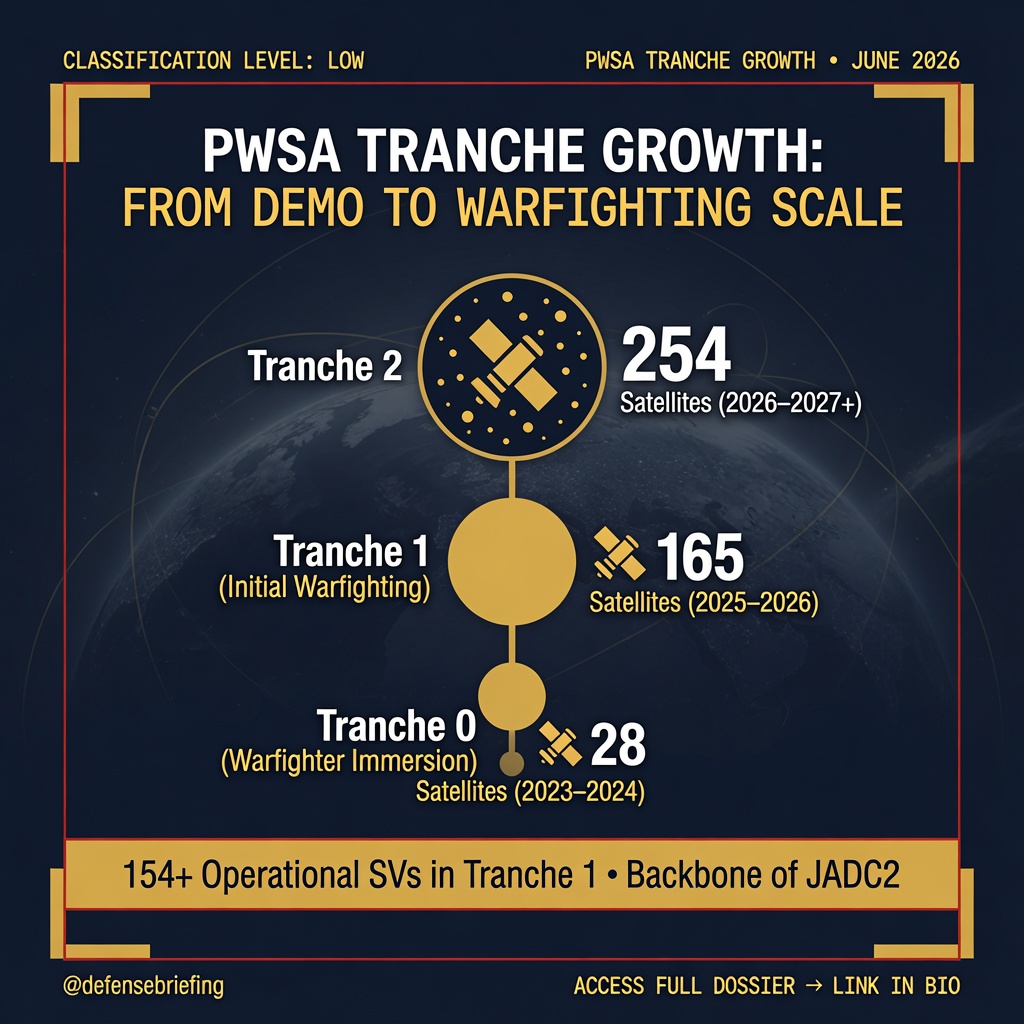
GAO's July 2025 tranche table showed the program scaling from a 28-satellite demonstration tranche to hundreds of planned satellites across Tranche 1 and Tranche 2. Graphic: Defense Briefing using GAO analysis of SDA data.
That is the uncomfortable part. The Pentagon is not just buying satellites. It is buying confidence that a mixed-vendor laser network will work at operational scale.
GAO offered a sharp critique of SDA's spiral development framework, noting that iterative acquisition requires data from each deployment to inform subsequent phases. Instead, SDA has managed its capability tranches with independent development schedules, assuring investigators that delays in one tranche would not disrupt future timelines. GAO responded that decoupling these schedules risks cascading technical complexity into future tranches before baseline capabilities are fully verified, structurally compounding systematic risk across the architecture.
The truth, as usual, lies somewhere in the middle. While GAO focuses on rigid schedule dependencies, SDA's model relies on the fact that an active constellation is a living laboratory. The moment satellites are in orbit, they begin generating operational data. This means the agency does not need a tranche to be fully complete to harvest critical insights. Empirical data on network routing, laser cross-links and sensor payloads can flow continuously, mitigating risk by informing the next engineering cycle.
In January 2026, GAO returned with a follow-on review of SDA's missile-warning effort and found a wider pattern. The report found that the agency was overestimating the technology readiness of some critical elements, which forced contractors into unplanned rework that added delays. SDA kept awarding new tranche contracts every two years irrespective of satellite performance. It had no architecture-level schedule, relying instead on individual contractor schedules. And DoD did not know the full life-cycle cost, because GAO said SDA had not built a reliable cost estimate. GAO's title said the quiet part out loud: SDA should be more realistic and transparent about risks to capability delivery.5
The first warning light came from Tranche 0. SDA originally planned to demonstrate optical terminals built by different vendors. GAO said SDA later shifted toward a narrower demonstration involving terminals from the same vendors in the same orbital plane. SDA officials said there had been a laser link between York Space Systems and SpaceX satellites, but GAO noted both used the same optical-terminal developer. That means SDA had not yet demonstrated an in-space link between two different optical-terminal vendors as originally planned.
That is not a small technical footnote. It is the heart of the architecture. A proprietary system like Starlink can solve compatibility by owning the stack: SpaceX controls satellites, terminals, launch, software, network management and operations. The Pentagon is trying to do something harder: make rival firms behave like one network while preserving competition.
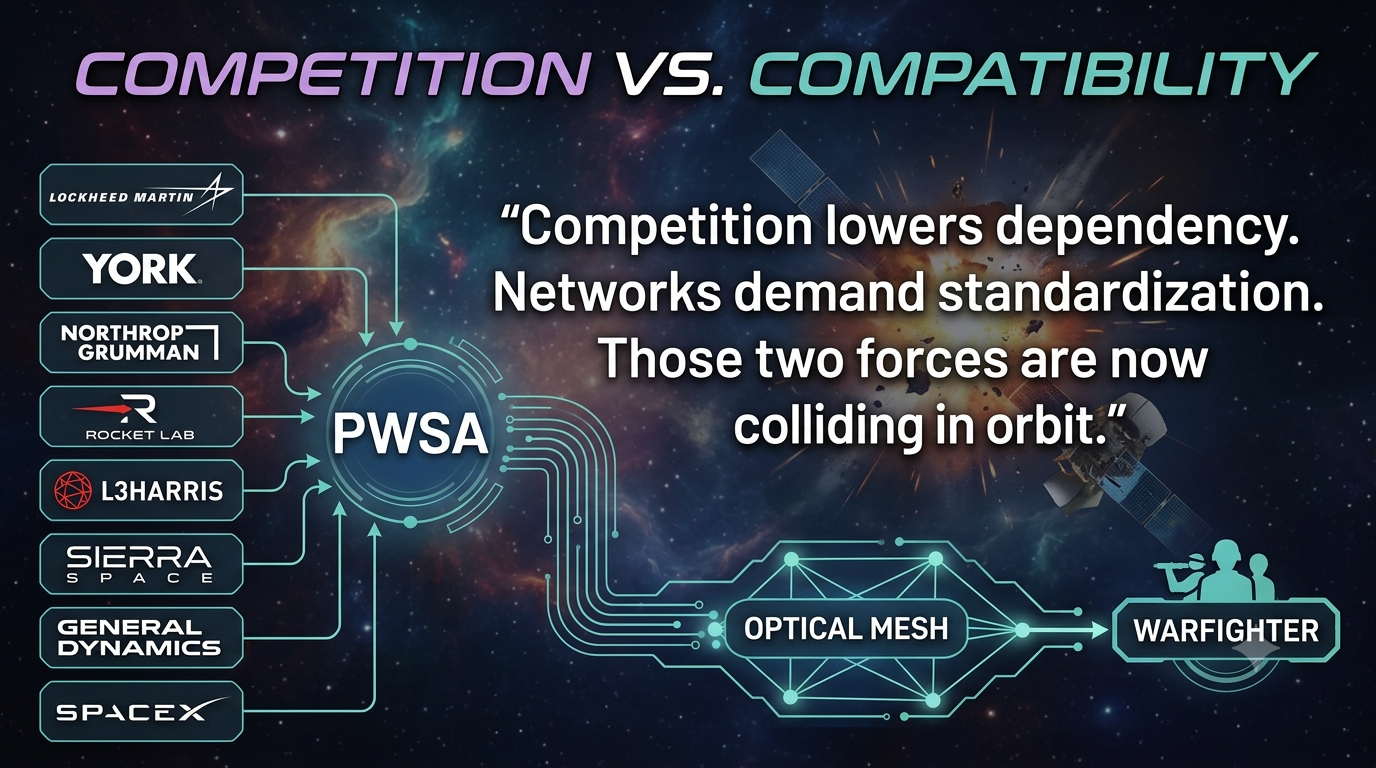
Competition lowers dependency. Networks demand standardization. The SDA model depends on both being true at the same time. Graphic: Defense Briefing.
“Competition lowers dependency. Networks demand standardization. Those two forces are now colliding in orbit.”
The Physics Works
The wrong takeaway is that laser communications in space are science fiction. They are not.
Europe demonstrated the first laser data link between satellites in 2001, when the European Space Agency (ESA) established an optical connection between its Artemis satellite and the French SPOT-4 Earth observation satellite. Europe then built that heritage into the European Data Relay System, also called SpaceDataHighway, which Airbus says has provided years of in-orbit laser service, including transfer rates up to 1.8 gigabits per second and more than 80,000 successful laser connections by 2024.
SpaceX scaled the concept to an unprecedented degree. At the 2024 SPIE Photonics West conference, SpaceX engineer Travis Brashears reported that Starlink's laser links move roughly 42 petabytes of data daily across its constellation. Though this volume is a company-disclosed claim rather than a government-audited statistic, the broader takeaway is indisputable: optical lasers can handle high-capacity satellite-to-satellite data routing at operational scale.
Physics is not the scary part. Satellites in LEO travel around 17,000 miles per hour, but optical links care about relative motion, not speed on a bumper sticker. Two satellites in similar orbits move in predictable paths relative to each other. The real engineering challenge is pointing, acquisition and tracking: finding the other satellite, locking onto it and keeping a very narrow beam aligned across hundreds or thousands of kilometers. That is hard. It is not magic.
The optical terminal needs accurate position data, precise steering mirrors, stable thermal control and software that can correct tiny errors in real time. It also must account for light-travel time, because the receiving satellite will have moved slightly by the time the beam arrives.
Therefore, the question is not whether optical inter-satellite links can work. They can. The question is whether the Pentagon can make optical terminals from different vendors work inside one contested, secure, military-grade architecture.
The Mesh Is Not There Yet
In March 2026, the warning light was still blinking. Gurpartap “GP” Sandhoo, SDA's acting director, told the Satellite 2026 conference in Washington that the agency had “not yet started building up the optical mesh in Tranche 1” and that it was about three months behind on that process.
Aerospace America reported that SDA had delivered 42 of its planned 154 Tranche 1 satellites since the first launch the previous September. Breaking Defense reported the same basic signal: Sandhoo said SDA had not established the Tranche 1 mesh network yet and wanted to begin building up the optical mesh within six months. He also said the agency had taken a strategic pause after finding issues in checkout of the 42 satellites already on orbit.
This deceleration is not a sign of failure. It is the reality of managing a complex, data-driven aerospace program. SDA is trying to solve one of the most difficult physics and business puzzles in modern aerospace: fast-moving orbital assets maintaining seamless communication links in real time, even when the hardware originates from competing manufacturers. The bottleneck is appearing precisely where critics predicted: not in launch frequency or hardware manufacturing, but in the grinding process of system integration.
Recent testing confirms that SDA's foundational technology is progressing. A 2025 demonstration successfully established two-way optical communication between a General Atomics terminal on an aircraft and a Kepler satellite, validating the agency's cross-vendor interoperability standards. York Space Systems added to this with a proven space-to-ground laser link. These milestones matter. They do not yet equal a comprehensive, battlefield-ready mesh network.
The Enemy Gets a Vote
Every military network has two audiences: the operators who need it to work and the adversaries trying to make it fail. PWSA is designed for a battlefield where satellites are no longer protected rear-area infrastructure. They are targets.
The Space Force says China and Russia are testing and fielding counterspace capabilities meant to disrupt and degrade U.S. space-enabled systems. The Defense Intelligence Agency (DIA) has warned that directed-energy weapons threaten space operations, and its public reporting states that Russia has ground-based lasers capable of blinding satellite sensors. Public reporting on the same DIA assessment said China has multiple ground-based laser systems that can disrupt, degrade or damage satellite sensors.6
Laser communications have real security advantages. A narrow optical beam is much harder to intercept than a broad radio frequency transmission. An adversary generally cannot sit miles away and casually listen in. To intercept the beam directly, it would have to be in or near the beam's path. That is no easy task.
Transitioning to a proliferated network does not eliminate risk. It changes the math. Vulnerabilities can emerge across hardware components, ground stations and software interoperability layers. The strength of the architecture lies in scale and routing: if individual nodes or paths are compromised, the broader system is supposed to retain its edge.
The core strength of a proliferated architecture is its ability to absorb disruption by routing data around affected units. If a node is lost, the network adapts, a replacement is launched and software patches are deployed in an ongoing cycle of iteration. Adversaries may avoid a total kinetic strike in favor of targeted degradation: injecting delay, confusion or mistrust during critical targeting windows. This quiet electronic battlefield is precisely why the architecture was built.
The Capital Signal
This is where the story becomes more than a Pentagon acquisition fight. The winners in the next phase of the space economy will not simply be the companies that build the cheapest satellite bus. The money will flow to firms that can make hardware behave inside the larger kill web.
That means optical communications terminals. Network management software. Crosslink routing. Encryption. Ground entry points. Cybersecurity. Manufacturing scale. Rapid replenishment. Test infrastructure. Integration support. And, perhaps just as important, the ability to survive the audit trail.
The Space Force's newer Space Data Network Backbone shows the same logic spreading beyond SDA. In May 2026, Space Systems Command awarded SpaceX a $2.29 billion agreement for a proliferated LEO satellite constellation intended to provide high-capacity, low-latency data transport. The official release described an expanded optically interconnected mesh of satellites and required delivery of a fully operational prototype by the end of 2027. The Space Force said the backbone would be integrated with SDA's Transport Layer as part of a broader hybrid mesh.7
The strategic reality is clear: the Pentagon has pivoted from buying individual satellites to procuring orbital networks. Yet in executing this pivot, procurement is concentrating around a dominant vendor, creating the exact proprietary dependency that proliferation was designed to reduce. For industry observers, the discrepancy between multi-vendor rhetoric and centralized funding is stark. The market mandate has shifted. Future success belongs to agile players that can force their way into the network through undeniable technical interoperability.
The Bet
The traditional defense procurement model managed risk by relying on a small cartel of massive contractors and heavily armored, exquisite satellites. The pivot away from legacy aerospace primes to an open-market, proliferated architecture was a necessary disruption. Creating paperwork competition among commercial upstarts is easy; forcing their proprietary hardware to coordinate data in a contested environment is the real war.
GAO's core concern is that SDA's aggressive launch cadence is outrunning its validation data. While GAO suggests more verification, SDA recognizes that speed is its best defense. China will not wait for GAO's approval. This is a real-world stress test of the “fail fast” commercial technology ethos applied to national survival.
The strategic payoff is an orbital highway that could make adversarial counterspace operations far harder to execute cleanly. The downside risk is a multi-billion-dollar network of isolated systems. The hardware is flying. The infrastructure is there. The only question left is whether the mesh can hold the line.
Forward this to the portfolio manager who still thinks satellites are just hardware.
Sources: Government Accountability Office, GAO-25-106838 and GAO-26-107085; Space Development Agency PWSA Tranche 1 fact sheet and September 2025 Tranche 1 launch release; Department of Defense, State of Competition Within the Defense Industrial Base, February 2022; Space Systems Command Space Data Network Backbone award release, May 26, 2026; York Space Systems optical laser communications demonstration release; reporting from Aerospace America, and Breaking Defense, and SpaceNews and Defense Daily from the March 2026 Satellite conference; European Space Agency and Airbus public materials on Artemis / SPOT-4 and SpaceDataHighway; Defense Intelligence Agency and U.S. Space Force public counterspace threat materials. No classified information was used and all material is publicly accessible.