
Beyond the Last Supper: How the Pentagon’s Orbital Mesh Is Breaking the Prime Monopoly
In the 1990s, Pentagon-mandated consolidation created five dominant defense primes. Fast-forward to 2026: the U.S. is shifting from exquisite, monolithic platforms to proliferated, open-standard networks, with the Space Development Agency rewriting the rules of the defense industrial base.
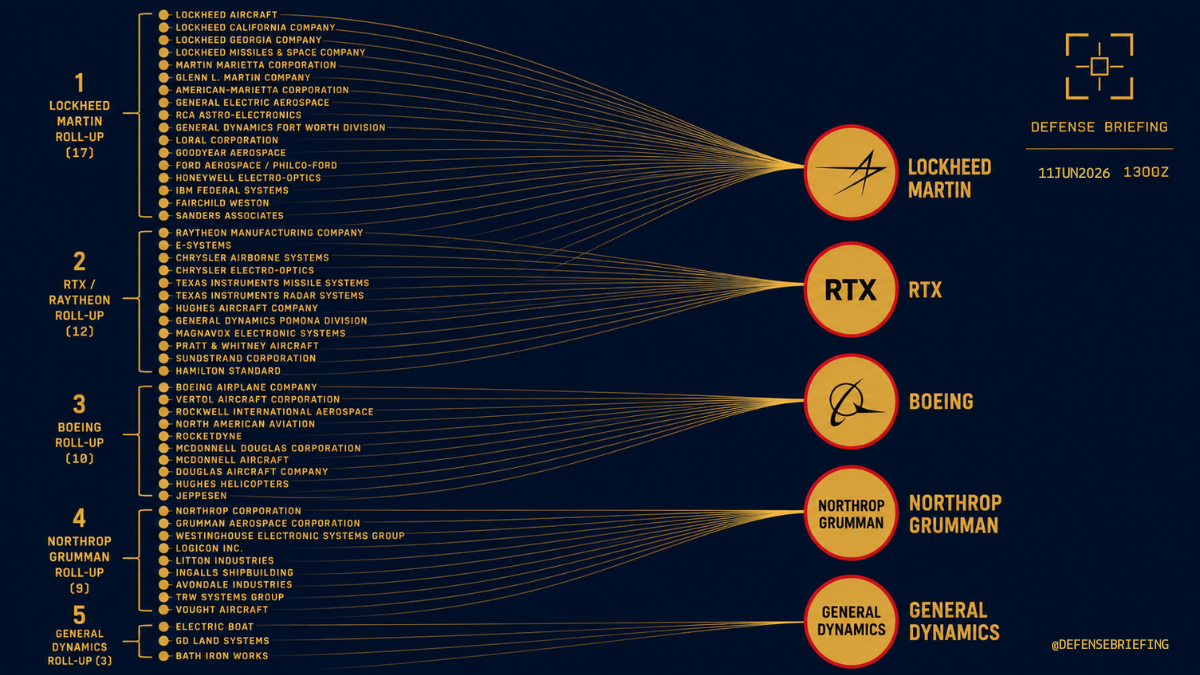
The U.S. defense industrial base consolidated from dozens of major contractors into five dominant primes following the post-Cold War drawdown. Graphic: Defense Briefing.
The Consolidation That Created an Oligopoly
In 1993, Defense Secretary Les Aspin and his deputy, William Perry, invited the chief executives of the largest U.S. defense contractors to dinner at the Pentagon. The message was blunt: the Cold War was over, budgets were collapsing and the Pentagon could no longer sustain dozens of independent prime contractors. Merge or exit.
Martin Marietta CEO Norm Augustine, seated beside Aspin that night, coined the name that stuck: the Last Supper. The dinner triggered a decade of consolidation. The 1990s squeezed plenty of industries into fewer hands; media, food and healthcare all centralized.
Defense went further. By the early 2000s, 51 prime contractors had collapsed into five dominant primes: Lockheed Martin, RTX, then Raytheon, Boeing, Northrop Grumman and General Dynamics. 1
“Nearly 70% of the companies were basically absorbed.”
Norman Augustine, CEO, Martin Marietta
The space model that emerged was straightforward and, for its time, rational:
- Build a small number of highly capable, exquisite satellite platforms
- Launch them into higher orbits
- Keep them secure
That design rested on two assumptions: space would remain a sanctuary, and quality could substitute for quantity. It also assumed that fielding satellites would never become economically viable for small companies, much less for rival nations.
The cost of reaching orbit alone was exorbitant. Getting hardware past the Kármán line, the 100-kilometer boundary commonly used to mark the edge of space, was an elite and restrictive endeavor.
Thirty-three years later, those assumptions no longer hold. Launch costs have fallen dramatically over the past two decades, driven largely by reusable rockets and commercial competition. That one economic shift rewrites space defense math. Cheaper cost per kilogram shrinks the penalty of any single launch failure, which lets the Pentagon treat low-Earth orbit (LEO) as a hardware testbed rather than an unforgiving, high-stakes vacuum.
Orbital delivery stops being a capital bottleneck and starts behaving like a commodity. That is what makes it possible to deploy, and continuously refresh, the hundreds of satellites a network requires.
Adversaries spent those same two decades building counterspace weapons: direct-ascent anti-satellite missiles, co-orbital systems, jamming and laser dazzling, all designed to hold small numbers of high-value assets at risk. A single point of failure in orbit could lead to strategic consequences.
The Pentagon's response inverts the old logic. Instead of concentrating capability in a few protected satellites, distribute it across hundreds of lower-cost nodes in LEO that can route around damage and be refreshed on faster cycles. Whether that delivers substantial advantages, serious disadvantages or, more likely, a mix of both remains to be seen.
Welcome to Orbital Intel, presented by Defense Briefing. Every Wednesday, you receive the week's defense, aerospace and space economy signal in plain language. Primary sources. No hype. Built for analysts, operators and the curious.
Today's headlines are rarely new. They're sequels. We deliver the prequels.
The Architecture That Changed the Equation
PWSA IN 30 SECONDS
- • Hundreds of interconnected satellites
- • Laser links connecting spacecraft
- • Missile warning and missile tracking
- • Tactical communications worldwide
- • Built to survive attack through redundancy
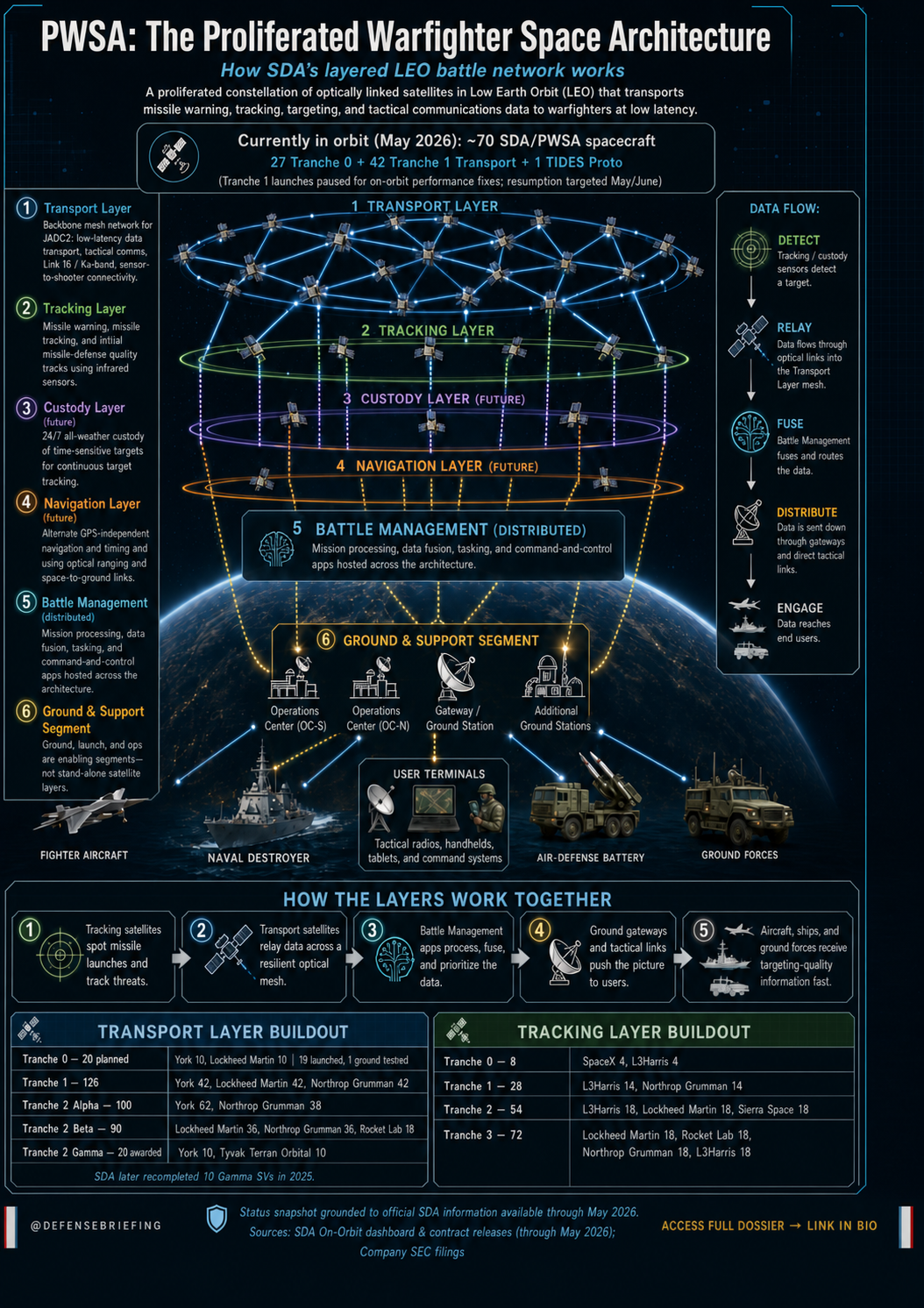
The Space Development Agency's Proliferated Warfighter Space Architecture combines missile tracking, communications transport and battle management into a distributed orbital network. Graphic: Defense Briefing using publicly available SDA information.
The Space Development Agency's (SDA) Proliferated Warfighter Space Architecture (PWSA) is that inversion made physical. Its core consists of two layers:
- The Transport Layer: an orbital data highway. Satellites talk to each other through optical communications terminals, lasers in plain terms, while also talking to aircraft, ships and ground forces through Ka-band radio and Link 16, the jam-resistant, encrypted tactical data network already standard across U.S. and allied forces. Sensor data and command traffic move between orbit and the battlefield with low latency.
- The Tracking Layer: proliferated missile warning and missile tracking. Infrared sensors detect ballistic and hypersonic threats and maintain custody as they fly.
A Battle Management Command, Control and Communications (BMC3) capability hosted across the architecture handles tasking and data dissemination. Tranche 1, the initial warfighting capability tranche, totals 154 operational satellites, 126 Transport plus 28 Tracking, along with four missile defense demonstration vehicles. Deployments began in September 2025 and continue through 2026. Tranche 2, the next two-year spiral, is already under contract. 2
The design relies on open standards: SDA's Optical Communications Terminal (OCT) standard and the Network Established Beyond the Upper Limits of the Atmosphere (NEBULA) networking protocol. Satellites from different manufacturers are required to interoperate on the same orbital mesh. This is not a collection of proprietary stovepipes. It is shared infrastructure built by competitors who historically did not operate this way.
That is the part most coverage skips. Previously, if one contractor built a satellite and a different contractor built the ground station, the two could not easily communicate without a complex, multimillion-dollar translation bridge on the ground. That incompatibility generally worked in the primes' favor; proprietary interfaces meant long, expensive, single-vendor lifecycles.
SDA inverted the power dynamic by mandating two open standards and forcing every vendor onto the same baseline protocols. Again, this could lead to substantial advantages, serious disadvantages or, more likely, a mix of both. But ultimately, the hardware becomes a plug-and-play commodity:
- Mandated interoperability: Satellites built by corporate rivals such as Lockheed Martin, Northrop Grumman, York Space Systems and SpaceX must pass data to one another by laser while moving at roughly 16,500 miles per hour. York and SpaceX demonstrated the first such cross-vendor laser link in 2025.
- Shared risk and infrastructure: If an adversary compromises a node built by Vendor A, the network routes tactical data through nodes built by Vendors B and C. The constellation stops being a set of closed corporate silos and becomes a shared, survivable data highway.
- Industrial base and expansion: Open standards let non-traditional companies build specialized payloads that plug directly into the network backbone, loosening the legacy giants' grip on the mission.
Defense primes are capitalist entities driven by competitive advantage, leverage and survival. They are complying with OCT and NEBULA because that is where the fixed-price contract money is. Expect them to keep hunting for proprietary advantages built on top of the open stack.
Primary-source analysis on defense, aerospace and the space economy, delivered weekly.
Subscribe FreeThe New Contractors are Already Executing
The early volume leader is York Space Systems, a Denver-based contractor founded in 2012 to challenge the legacy primes with modular, lower-cost satellites built at production-line cadence.
York delivered the first operational batch: 21 Tranche 1 Transport satellites on a single SpaceX Falcon 9, launched September 10, 2025 from Vandenberg Space Force Base. Its SDA awards now span 42 Tranche 1 Transport satellites, 12 Tranche 1 Demonstration and Experimentation System (T1DES) satellites, 62 Tranche 2 Transport-Alpha satellites and 10 Tranche 2 Transport-Gamma satellites, more than 120 spacecraft across Tranches 1 and 2, on top of its original Tranche 0 work. 3
York's Form 10-K identifies the company as the PWSA's largest awardee by contracts and spacecraft on orbit as of December 2025. The firm reported $386.2 million in 2025 revenue, up 52% year over year, and guided 2026 revenue to $545 million to $595 million, over 70% of which it expects to come from existing backlog. SDA remains its largest customer; a concentration York itself flags as a risk factor. 4
York will not have the field to itself. Lockheed Martin matched York's 21-satellite Tranche 1 launch in October 2025. Northrop Grumman holds announced PWSA awards exceeding 130 satellites. Rocket Lab is building 18 Tranche 2 Transport-Beta satellites. SpaceX built Tranche 0 Tracking satellites and operates its own Starshield network for national security customers. Volume leadership will be contested tranche by tranche.
Beyond the mesh itself, specialized players logged three notable moves this past week alone:
- BlackSky: Awarded a National Reconnaissance Office (NRO) contract modification June 9 to accelerate its AROS broad-area collection satellites as a commercial alternative for foundation imagery, the base-layer mapping data underneath navigation, maritime awareness and digital twin products, with a flight-ready system targeted for 2028.
- Spire Global: Signed a memorandum of understanding with Germany's Diehl Defence June 10 at the ILA Berlin Airshow to explore satellite-based early warning against ballistic and hypersonic missiles. It is exploratory, no contract award and no disclosed financial terms, but it signals allied appetite to plug proliferated commercial constellations into European missile defense.
- Intuitive Machines: Awarded a $1 million Build Our Future grant June 10 by the Maryland Department of Commerce to expand its Super Cislunar Robotics Assembly Building in Glen Burnie, Maryland, growing the mechanisms and robotics work behind sustained lunar surface operations and longer-term cislunar infrastructure.
These are not traditional primes scaled down, nor subsidiaries of the Big Five. They are smaller organizations optimized for iteration, fixed-price execution and payload-agnostic platforms. Collectively they broaden an industrial base that consolidated to five companies in the 1990s.
Why It Matters for National Security
Legacy architecture carried a lone-sniper problem: disable a handful of exquisite, multibillion-dollar satellites and you disable U.S. space capability. Under the proliferated LEO model an adversary faces hundreds of interconnected nodes, and the network is built to route around every individual failure. That is the design theory. The resilience is engineered, not yet proven at scale in combat, and honest analysis keeps that distinction visible.
The acquisition tempo matters as much as the orbital geometry. Instead of once-per-decade overhauls, SDA fields a new tranche roughly every two years, refreshing technology on a cycle intended to outpace adversary countermeasures rather than chase them.
Tactically, the network attacks sensor-to-shooter latency. Jam-resistant, encrypted Link 16 connectivity delivered from orbit bridges previously siloed sensors and weapons across land, sea, air and space. That is the data transport foundation for Joint All-Domain Command and Control (JADC2), the Pentagon's effort to move data faster than an adversary can decide, and it is designed to keep working inside high-intensity electronic warfare environments.
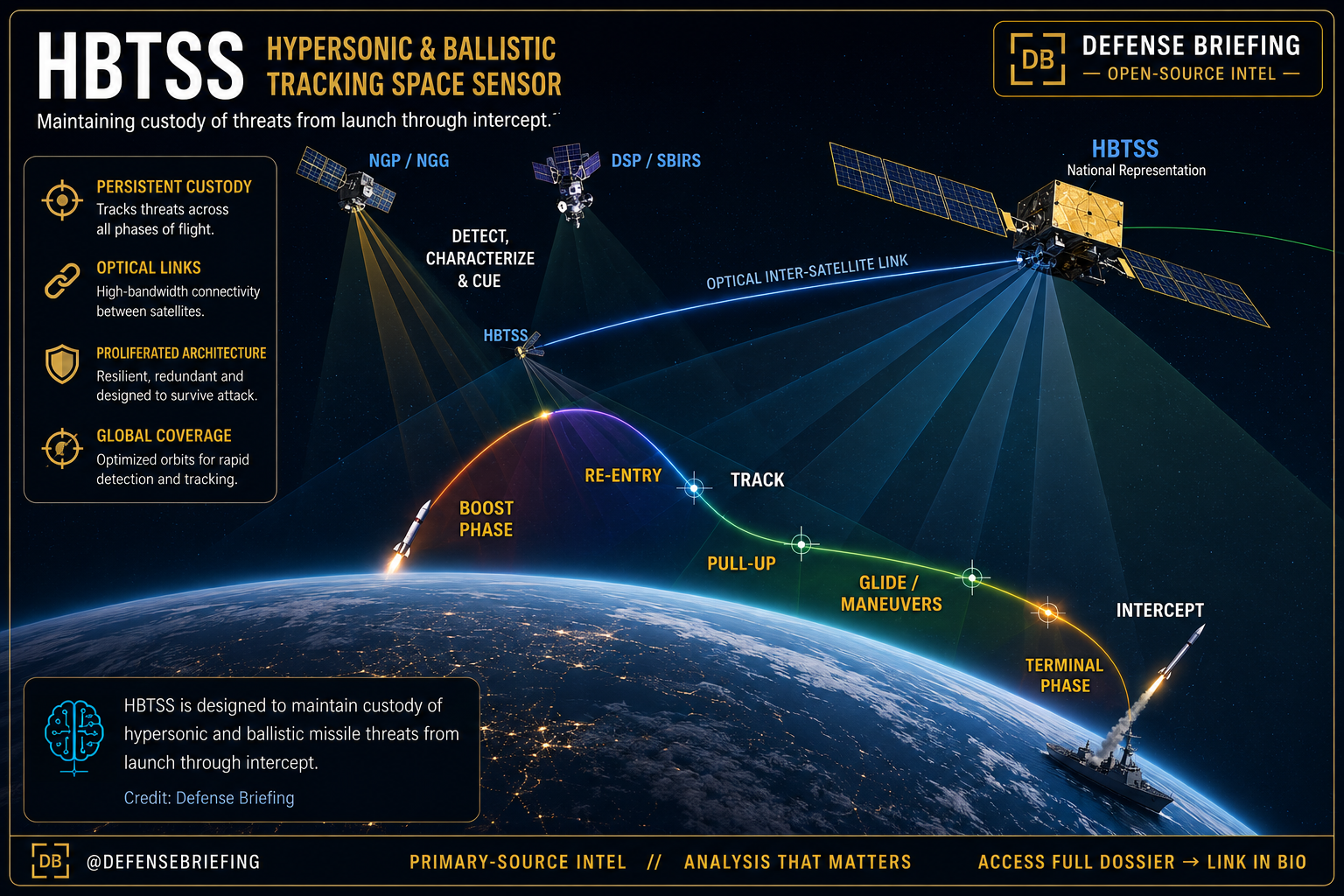
HBTSS is designed to maintain custody of hypersonic and ballistic missile threats from launch through intercept. Credit: Missile Defense Agency.
The endgame is Golden Dome, the Trump administration's homeland missile defense initiative. Defending against hypersonic and ballistic threats requires “fire-control quality” tracking: sensor data precise, secure and timely enough to guide an interceptor to a high-speed target.
That capability cleared a meaningful gate in April 2025 when the Missile Defense Agency (MDA) confirmed that L3Harris' Hypersonic and Ballistic Tracking Space Sensor (HBTSS) prototype met performance targets in on-orbit tests. Exact tracking tolerances remain classified. The engineering problem is unforgiving either way: maintain custody of dim, maneuvering targets while rejecting orbital debris, laser dazzle and radio-frequency interference, and while absorbing the possibility of physical attack on the nodes themselves. The architecture is jam-resistant by design. Nothing in orbit is invulnerable. 5
One caveat belongs on the record. The multi-vendor Transport Layer is funded through Tranche 2, but the Space Force's fiscal 2027 request includes no funding for Tranche 3 and rolls its requirements into a new Space Data Network anchored on SpaceX's Starshield. Congress pushed back once already, restoring Tranche 3 money in the fiscal 2026 authorization. Whether the open-standards mesh or a single-vendor backbone carries the transport mission past 2027 is now a live budget fight; we covered the SpaceX side of that ledger in Transmission 002.
“The Pentagon is no longer buying a small number of exquisite satellites. It is buying a network.”
Primary-source analysis on defense, aerospace and the space economy, delivered weekly.
Subscribe FreeWhy It Matters for Capital
The Department of Defense (DoD) and the National Aeronautics and Space Administration (NASA) are leaning hard on fixed-price Other Transaction Authority (OTA) agreements, a contracting instrument exempt from the Federal Acquisition Regulation (FAR), the rulebook that governs standard federal procurement. OTAs are not new. What is new is the scale of their use. They let agencies set terms, timelines and pricing that mirror commercial practice, and they lower the bureaucratic barrier for non-traditional entrants: startups, emerging technology firms, even academic institutions. 7
The risk transfer is the point. Fixed-price OTAs reward schedule execution and put design delays and component bottlenecks directly on the contractor's balance sheet, while paying out predictable milestones to vendors who deliver. Pair that with SDA's two-year tranche cadence and the development loop compresses hard.
Capital markets are starting to price the difference. Physical throughput, meaning production capacity, payload integration speed and realized on-orbit performance, is separating margin-expanding executors from vendors holding low-yielding paper backlog.
The addressable market is widening as Golden Dome funding builds; York's 10-K cites a projected Space Force fiscal 2026 budget of approximately $37 billion and approximately $175 billion in total projected Golden Dome spending. The open-standards baseline also creates an allied integration surface. The Spire-Diehl agreement is an early signal that European architectures want to connect to proliferated, commercially built networks, which would extend follow-on opportunities into a multi-customer export market. Whether that converts into booked revenue is an open question, not a given. 8
Over the long term, margins have structural room to expand: falling launch costs, factory learning curves, component standardization and automated assembly. Satellite manufacturing is shedding its bespoke, hand-built heritage for assembly-line mechanics, and that improves visibility into long-term cash flows. It does not guarantee winners. Defense Briefing does not make “buy” or “sell” calls; we surface the structure and let you do the allocating.
“This is not a future concept. It is the operating reality.”
The Bottom Line
The Pentagon is no longer buying a small number of exquisite satellites. It is buying a network.
That distinction matters.
For decades, being a prime meant building tanks, aircraft or a handful of bespoke satellites under the model forged at the Last Supper table. Production cycles were long, upgrade cycles longer and revenue concentrated in a few major programs.
A new class of space primes runs the opposite play: smaller footprints, agile partnerships and redundant networks instead of singular platforms. Factory throughput now ranks alongside legacy engineering benchmarks as a core strategic metric. The test is the ability to scale, integrate diverse payloads quickly and hit deployment schedules.
This experiment has room for substantial successes and substantial failures, and not every participant will emerge a long-term winner. Execution is the differentiator, and execution is finally measurable: the satellites are launching, the backlog is converting and the orbital mesh is forming, tranche by tranche. This is not a future concept. It is the operating reality.
Thirty-three years after the Last Supper consolidated America's defense industry into a handful of dominant primes, the Pentagon is quietly creating the conditions for the next generation of contractors to emerge.
Forward this to the portfolio manager who doesn't think space is the future and needs the signal.
All reporting is based on public government records, company filings, official releases and linked primary or attributable secondary sources. No classified information was used.