
The Disappearing Agency
The Space Development Agency built the Pentagon's satellite mesh to break single-vendor dependency. Now its standalone identity is being pulled into the Space Force's portfolio acquisition system, its mission is expanding and the next Transport Layer contract York Space Systems expected to compete for sits inside an unresolved fight between speed and competition.

The Space Development Agency (SDA) is not dead. That is the first thing to get straight. The mission it built, a proliferated low-Earth orbit (pLEO) satellite mesh for missile warning and military data transport, is becoming more important, not less. What is changing is the wrapper around it: SDA's standalone acquisition identity is being challenged just as the Space Force builds a larger Space Data Network (SDN) around the same mission set.
If you have tried to follow this and come away confused, you are not alone. The confusion is real because three different fights are happening at the same time, on three different clocks. None of it lines up cleanly.
Welcome to Orbital Intel, presented by Defense Briefing. Every Wednesday, you receive the week's defense, aerospace and space economy signal in plain language. Primary sources. No hype. Built for analysts, operators and the curious.
Today's headlines are rarely new. They're sequels. We deliver the prequels.
One is a budget fight: the Pentagon keeps trying to reallocate part of SDA's transport architecture, and Congress keeps forcing the money back in. One is an organizational fight: does SDA remain a distinct rapid-acquisition organization inside the Space Force, or do its authorities get absorbed into the service's broader portfolio structure? One is an architecture fight: does the open, multi-vendor satellite mesh survive, or does a single dominant vendor quietly swallow the most valuable segment of it?
The headlines whipsaw because the Pentagon and Congress keep overruling each other, providing contradicting headlines with each breaking news alert. And because budget documents often describe what the Pentagon wants before Congress has finished deciding what it will allow, the public is left bewildered. But when we read the three fights separately, suddenly the fog lifts. Otherwise, you're stuck with the trade-press version, where SDA is simultaneously dying, expanding and being privatized. Next thing you know, you're shorting a stock based on false narratives and erroneous research reports.
1993 — The Last Supper. Pentagon leaders tell defense executives at a private dinner to consolidate or starve. Dozens of firms collapse into the mega-prime structure that still dominates the defense industry.
Dec. 21, 2015 — Reusable launch becomes real. SpaceX lands an orbital-class Falcon 9 booster after delivering satellites to orbit. The commercial launch era stops being a promise and becomes a cost curve the Pentagon can see.
March 12, 2019 — SDA is born. The agency is created to move in the opposite direction from the prime-dominated model: many cheaper satellites, multiple competing vendors and two-year build cycles called tranches.
Dec. 20, 2019 — Space Force is created. The U.S. military gets its first new armed service since 1947. SDA predates the Space Force by several months.
Oct. 1, 2022 — SDA transfers to Space Force. This is important. SDA has already been part of the Space Force since 2022. The current fight is not whether SDA joins the Space Force. It already did.
2023–2026 — The mesh starts flying. SDA begins fielding the Proliferated Warfighter Space Architecture (PWSA): a Transport Layer that moves data and a Tracking Layer that detects missiles, linked by optical communications.
2026 — The irony arrives. The agency created to break single-vendor dependency is now at risk of losing its separate identity just as one vendor's gravity grows over the segment SDA was meant to keep competitive.
Further reading: Defense Briefing covered the 1993 consolidation wave and the defense-prime oligopoly in Transmission 003.
The Timeline That Lifts the Fog
Read these events in order and the contradictions resolve into a single, coherent fight.
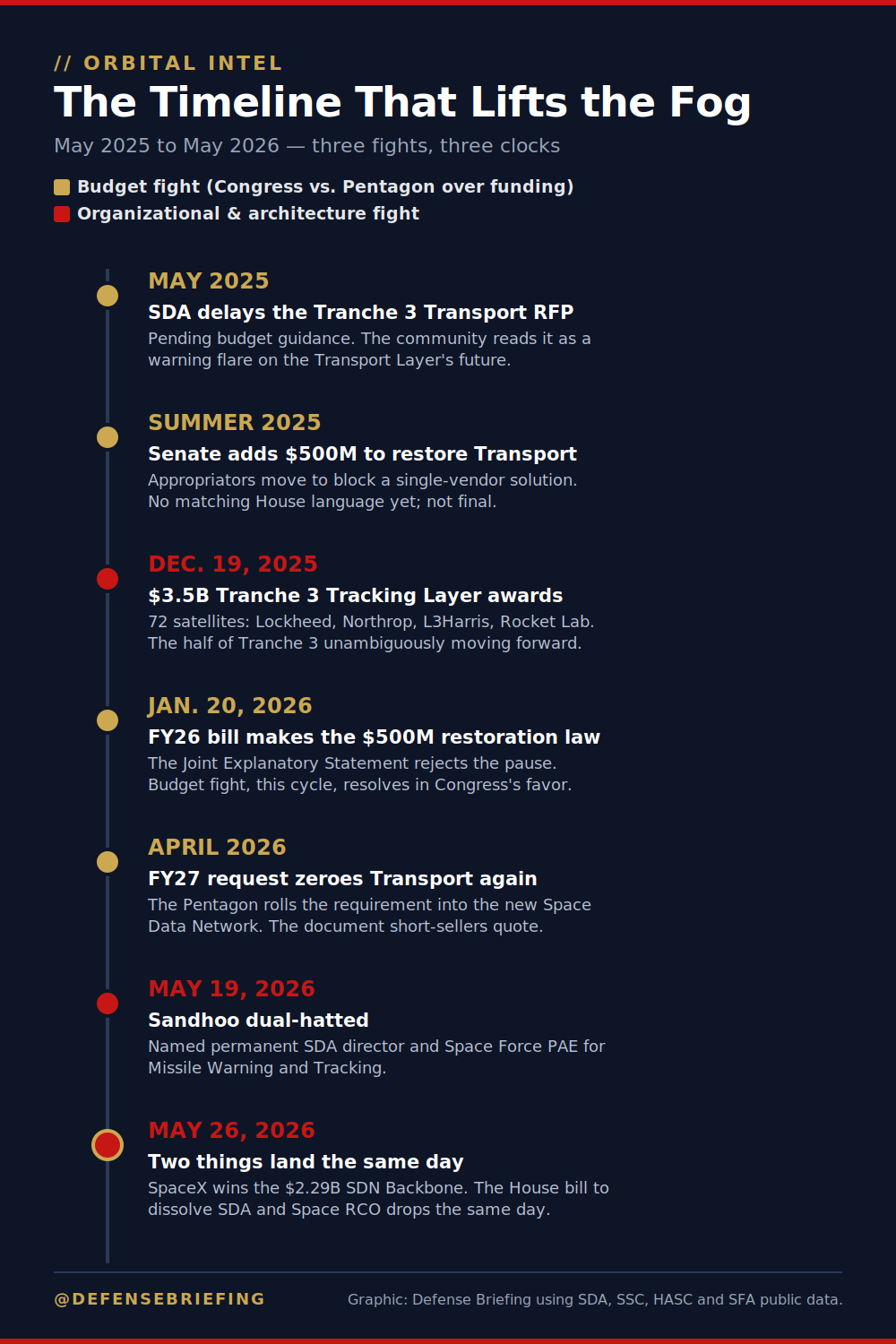
May 2025. SDA delays the request for proposals for its Tranche 3 Transport Layer satellites until it receives budget guidance. Inside the community, that reads as a warning flare. The Space Force Association, in an analysis written by retired Brig. Gen. Damon Feltman, former SDA Transport Cell chief, warns that postponing Tranche 3 Transport could add risk to missile-tracking connectivity, tactical data movement and industrial-base health.7
The concern is not abstract. SDA's Transport Layer is supposed to move missile-warning and targeting data through a resilient, military mesh. If that layer is delayed, reduced or folded into a different architecture, the Pentagon does not just change a contract vehicle. It changes how the network works.
Summer 2025. Senate appropriators push back. They vote to direct the Secretary of the Air Force to restore Tranche 3 Transport funding and add $500 million to the program. The stated purpose is to stop the Pentagon from pressing the easy button of a single-vendor solution. But the restoration is not yet the end of the story. House appropriators have no matching language, which sets up a conference-committee fight and a presidential signature before any of it is final.8
Dec. 19, 2025. SDA awards roughly $3.5 billion in firm-fixed-price agreements to build 72 Tranche 3 Tracking Layer satellites, four teams led by Lockheed Martin, Northrop Grumman, L3Harris and Rocket Lab, each delivering 18 satellites for a launch in fiscal 2029. This is the half of Tranche 3 that is unambiguously moving forward.1
Jan. 20, 2026. Congress makes the restoration real. The fiscal 2026 Defense Appropriations Joint Explanatory Statement rejects the Pentagon's proposed pause and adds the $500 million specifically to keep the Tranche 3 Transport Layer on schedule. The budget fight, for this cycle, resolves in Congress's favor.9
April 2026. The Pentagon releases its fiscal 2027 budget request and again proposes not to fund the Tranche 3 Transport satellites, rolling those requirements into the new SDN. This is the document recent short-seller commentary and trade headlines have quoted to argue Tranche 3 is dead.
May 19, 2026. Gurpartap “GP” Sandhoo is named permanent director of SDA and also becomes the Space Force Portfolio Acquisition Executive for Missile Warning and Tracking. That dual-hat matters. Sandhoo continues to lead SDA's Tranche 1 and Tranche 2 PWSA work, but he also gains authority over a wider missile-warning and tracking portfolio.2
May 26, 2026. Two things land the same day, and the coincidence tells the story. Space Systems Command awards SpaceX a $2.29 billion agreement for the SDN Backbone, a pLEO constellation for high-capacity, low-latency data transport that the Space Force says will integrate with SDA's Transport Layer as part of a broader hybrid mesh (Defense Briefing covered the award in Transmission 002). The same day, House lawmakers release fiscal 2027 defense authorization language that would eliminate SDA and the Space Rapid Capabilities Office (Space RCO) as separate statutory organizations, absorbing their programs and authorities into the Space Force's portfolio acquisition system. The backbone award and the bill that would dissolve SDA dropped simultaneously.45
That is the real picture. The Pentagon keeps trying to defund Tranche 3 Transport. Congress keeps reviving it. SDA already sits inside Space Force, but Congress is now debating whether its distinct legal and acquisition identity should disappear. SpaceX already has the SDN backbone award, but the broader architecture is not settled.
“The fight is paused, not resolved.”
So when a headline says the Pentagon killed Tranche 3 Transport, it is describing the Pentagon's budget wish while ignoring that Congress had already pushed back on exactly that move. Both things are true at once. That is not a contradiction in the reporting. It is a contradiction in the government.
What Happens to SDA
Start with the organizational question, because it is the one most often answered wrong. SDA was not outside the Space Force until now. It transferred into the U.S. Space Force on Oct. 1, 2022, and has since reported to the Assistant Secretary of the Air Force for Space Acquisition and Integration on acquisition matters and to the Chief of Space Operations for everything else. So the current question is not who SDA reports to once it joins the Space Force; it already joined. The better question is who owns the mission, the money and the decision rights if SDA loses its separate statutory identity.
The emerging answer is the portfolio acquisition executive structure. Under the House draft language, references to the director of SDA would be replaced by the Space Force portfolio acquisition executive for missile warning and tracking. That matters because Sandhoo now holds both jobs: SDA director and Space Force Portfolio Acquisition Executive for Missile Warning and Tracking. SDA's old chain was a semi-distinct rapid-acquisition shop inside Space Force; the new model makes its work part of a mission portfolio run through the service's broader acquisition system. That is not a small bureaucratic detail. It changes the logic of the organization.
Think of it less like a shutdown and more like a large company absorbing a smaller product team. The product keeps shipping. The engineers stay. The roadmap may even get more money. But the brand fades, the reporting line changes and the parent decides which parts survive as independent products and which become features inside the larger platform. That is the risk for SDA. The PWSA does not vanish. The missile-warning mission grows. But SDA as the disruptive acquisition brand, the shop built to move fast and keep multiple vendors in the game, may not.
The Space RCO piece matters for the same reason. Space RCO is the Space Force's classified fast lane, built to deliver urgent space and ground systems faster than the normal acquisition system when the threat clock demands it. Folding both SDA and Space RCO into the portfolio structure is not cleaning up an org chart. It is an attempt to turn two fast-moving exceptions into the operating model for the whole service. The upside is speed and tighter accountability. The downside is that the disruptive offices can lose the very independence that made them useful.
Tranche 3, Split in Two
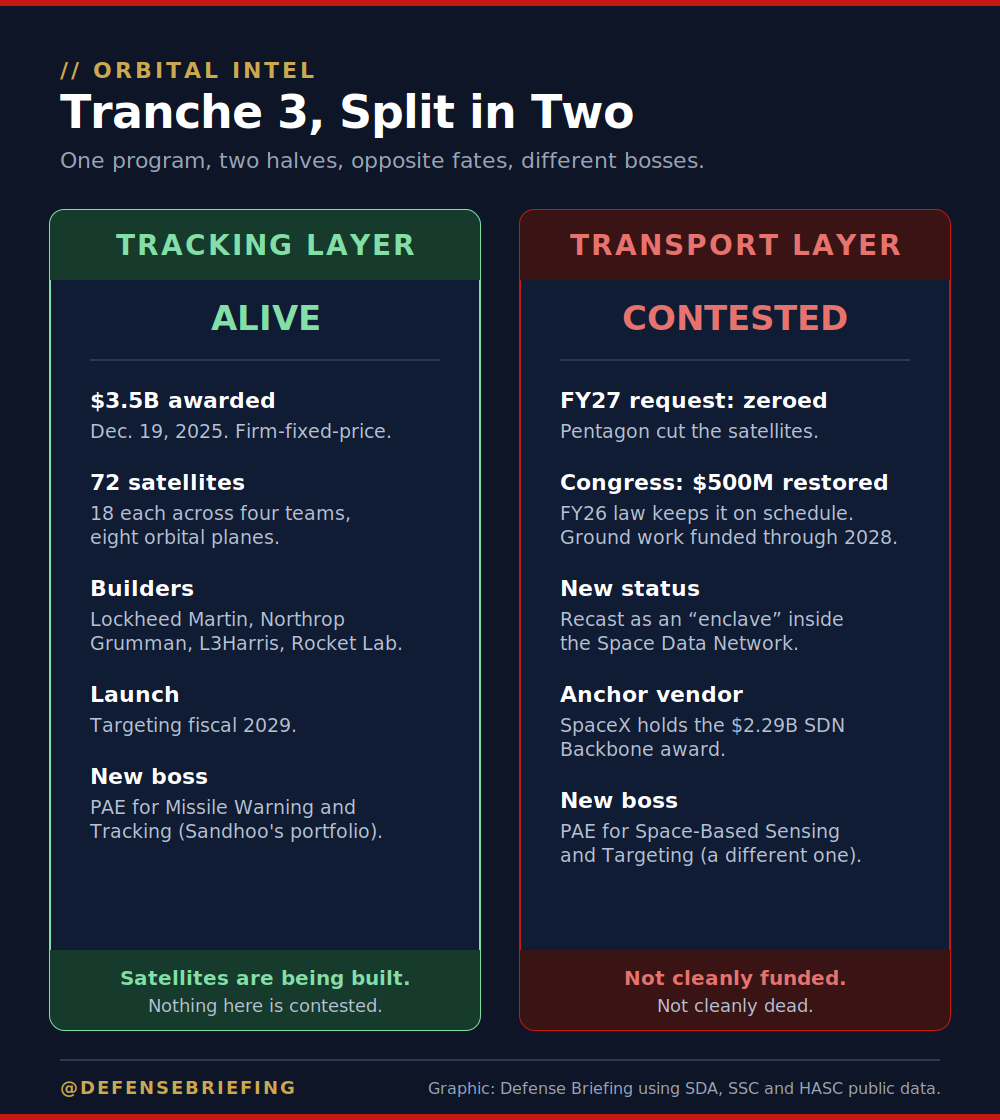
Here is where most coverage goes wrong: it treats Tranche 3 as one thing. It is two things, and the two halves have opposite fates. The reorganization makes the split sharper still, because the two halves are being routed to different bosses.
The Tracking Layer is alive. On Dec. 19, 2025, SDA awarded roughly $3.5 billion in Tranche 3 Tracking Layer satellite-build agreements to teams led by Lockheed Martin, Northrop Grumman, L3Harris and Rocket Lab, each delivering 18 satellites (72 in total) across eight orbital planes, targeting launch in fiscal 2029. These are firm-fixed-price agreements. The satellites are being built. Under the new portfolio structure, the Tracking Layer falls under the Portfolio Acquisition Executive for Missile Warning and Tracking, which is Sandhoo's own portfolio.1
The Transport Layer is contested. The Pentagon's fiscal 2027 request zeroed the Tranche 3 Transport satellites. But the same budget still funds Tranche 3 ground, integration and Ground Entry Point work through 2028, and Congress already restored $500 million for the satellites in the prior cycle. The Transport requirement is now being described as an enclave within the SDN, and under the reorganization it is slated to move under a different portfolio, the executive for space-based sensing and targeting, separate from the Tracking Layer it is built to serve.6
So the satellites are not cleanly funded in the Pentagon's plan, and not cleanly dead either, because Congress wants them and the ground work continues.
And the awards already handed out? Nothing gets clawed back. The Tracking Layer agreements proceed toward a 2029 launch. This is where the York Space Systems (York) question enters, because York's situation is the one short-sellers have seized on, and it is the cleanest test of whether the panic matches the contracts.
This is the part the casual observer misjudges. The Transport Layer is often dismissed as a smaller, government version of Starlink. It is not. Starshield is the government-focused version of Starlink.
Per the Space Force Association's analysis, SDA's Transport and Tracking satellites both fly at roughly 1,000 kilometers, while many commercial proliferated constellations operate lower, around 550 to 650 kilometers. That altitude gap is not a detail. It is a design constraint. Tracking satellites' optical links are built to connect across a specific orbital architecture. A commercial replacement flying lower may not be able to receive and move the missile-tracking data the Transport Layer exists to carry.7
Transport also carries capabilities a broadband constellation does not: Link 16 from space, reaching tens of thousands of existing tactical radios without modifying the terminals; navigation-warfare functions; and the “last tactical inch” connectivity to individual platforms. That is why Congress keeps getting involved. This is not just a satellite-internet procurement. It is the nervous system for a future missile-warning and targeting architecture.
Primary sources. No hype. Built for analysts and operators.
Read Orbital Intel every Wednesday.
SUBSCRIBEThe York Problem
York built the first batch of Tranche 1 Transport satellites to reach orbit and demonstrated a space-to-ground optical laser link with SDA. Its near-term backlog is intact. Tranche 1 still has more than 100 satellites left to launch, and the program has years of delivery ahead before the architecture is fully fielded. Nothing York has already won disappears because of the House authorization language.
The risk is forward. In its annual report for the year ended Dec. 31, 2025, York described itself as a prime awardee across PWSA Tranches 0, 1 and 2 with “an incumbent position leading into Tranches 3 and 4.” The same filing carries a blunt risk factor: York derives “substantially all” of its revenue and backlog from its largest customer, the SDA. The revenue table puts a number on it. Government work was $372.8 million of $386.2 million in total 2025 revenue, roughly 96.5 percent, and the SDA is the bulk of that. A material change in the SDA's mandate or spending, the filing warns, could materially reduce both revenue and backlog.10
Short-seller Wolfpack Research built a thesis on exactly that concentration. Its May 11 report, “YSS: Lost In Space,” opens by stating that 96 percent of York's 2025 revenue came from one customer, the SDA, “and that customer is being eliminated.” The report argues the Pentagon “wiped out future funding” for Tranche 3 Transport, that the program is being replaced by one “built around SpaceX as the sole-source provider,” and that the FY27 budget names Starshield explicitly with “no competitive solicitation for a second backbone satellite vendor.” Wolfpack predicts York misses its FY2026 revenue guide by roughly 30 percent.11
There you have it, SDA looks like it will be eliminated, future uncertain for $YSS who relied on the SDA for over 90% of revenues.
— Wolfpack Research (@WolfpackReports) May 28, 2026
Some of that is fair, and some of it the primary documents contradict. Start with what the report gets right: York's customer concentration is real and disclosed, the Pentagon's FY27 request did zero the Tranche 3 Transport satellites, and the reorganization does pull the requirement toward the SDN. Those are accurate.
But two of the report's load-bearing claims do not survive the source documents. First, “wiped out” overstates a budget request. The FY27 request is a proposal, not enacted law, and Congress had already restored $500 million to Tranche 3 Transport in the FY26 Joint Explanatory Statement, with the ground and integration work funded through 2028. The funding is contested, not gone. Second, and more central to the short thesis, the “sole-source” characterization is contradicted by the Pentagon's own budget document. The FY27 RDT&E justification book describes the effort as leveraging the “multi-vendor Space Data Network - Backbone (SDN-B) program.” The Pentagon's own words, in the same J-Book Wolfpack cites, call the program multi-vendor by design. SpaceX holds the first $2.29 billion backbone award; that is real. But “holds the first award” and “sole-source provider with no second vendor” are different claims, and the budget document supports the former, not the latter.12
Then there is the contract that supposedly vanished. There was no Tranche 3 Transport satellite award to York to cancel, because that competition had not been run. York stated an expectation, the incumbent's reasonable belief that it would compete well for Tranche 3 and Tranche 4, not a booked contract the reorganization erased. SDA's existing work continues. York's awarded work continues. The agency is being reorganized, not deleted, and the dependence the 10-K discloses is a real risk, not a realized loss.
That is the real market risk. Not collapse. Compression. If Tranche 3 Transport becomes an enclave inside the Space Data Network, York's path narrows. The company moves from competing in an SDA procurement model built around multiple vendors and repeat tranches to competing inside a broader Space Force network architecture where SpaceX already holds the $2.29 billion backbone award. That is a different game, and the incumbent advantage York is counting on means less inside it. Wolfpack is right that the growth thesis is impaired. It overreaches in calling the funding gone and the backbone sole-sourced, when Congress restored the money and the Pentagon's own book calls the program multi-vendor.
The Bottom Line
SDA is not disappearing because its mission failed. It is disappearing, or at least losing its separate identity, because its mission succeeded. The proliferated low-Earth orbit model is no longer a side project; it is moving toward the center of missile warning, tactical data transport, Golden Dome and the Space Force's future network. SDA won the architecture argument. The Pentagon wants the mesh. The Space Force wants the mission. Golden Dome needs the data. Nobody serious is walking away from the idea.
But SDA may lose the acquisition argument. The agency was built to prevent single-vendor dependency. Yet the Transport Layer, the part of the mesh that moves the data, is being pulled toward an SDN structure where SpaceX already holds the lead contract, the strongest execution record and the gravitational pull of a working proliferated constellation.
That does not make SpaceX the villain. On the public evidence, this is less a favoritism story than a performance story. The multi-vendor model has struggled with integration, optical-link interoperability and schedule pressure. SpaceX has shown the Pentagon what scale looks like. When budgets tighten and timelines matter, proven capacity becomes very hard to argue against.
But national security is not only about who can move fastest. It is also about who cannot be allowed to become irreplaceable. That is why Congress keeps pushing back. A single high-performing backbone may deliver capability faster. A multi-vendor mesh is harder to capture, harder to price-gouge and harder to break. The Pentagon wants speed. Congress wants competition. The Space Force wants a cleaner acquisition machine.
Three trip-wires decide whether SDA's model survives under a new name or disappears into the Space Force machine, and whether the old model still has room for anyone outside the dominant backbone provider. First, the NDAA conference report: if the final authorization bill preserves SDA's separate authorities or explicitly protects its acquisition approach, the name may fade but the model survives; if the House language holds without guardrails, SDA becomes a portfolio legacy. Second, the fiscal 2027 appropriations vote: if Congress restores Tranche 3 Transport satellite funding again, it is not just saving a budget line, it is forcing the Pentagon to keep a competed Transport Layer path alive. Third, the Space Data Network second-vendor path: whether the Space Force opens a real second-vendor lane inside the SDN, or lets the backbone award become the de facto architecture.
SDA is not dead. That is too simple. Its mission is bigger than ever. Its director has more authority than before. Its architecture is moving into the center of missile warning, Golden Dome and military data transport. What may be disappearing is more important than the agency name: the model that proved the Pentagon could buy space differently, faster, cheaper, more competitively and with less dependence on the old prime-contractor structure. The question now is whether the Space Force scales that model or buries it under the very acquisition machinery SDA was created to escape. The answer is not in the headlines. It is in the next funding line.
That is the real story: SDA may survive as a mission while disappearing as a method.
Forward this to the portfolio manager who still thinks “Tranche 3 is dead” is a complete sentence.
One agency. Three fights. One newsletter that keeps them straight.
Get Orbital Intel free, every Wednesday.
SUBSCRIBESources: Space Development Agency, Tranche 3 Tracking Layer award announcement, Dec. 19, 2025; Space Development Agency, director and portfolio acquisition executive announcement, May 19, 2026; Space Systems Command, Space Data Network Backbone award to SpaceX, May 26, 2026; House Armed Services Committee, fiscal 2027 National Defense Authorization Act chairman's mark; reporting from Air & Space Forces Magazine, SpaceNews and DefenseScoop on the proposed elimination of SDA and Space RCO; Space Force Association analyses of the Tranche 3 Transport postponement and Transport Layer architecture (May and August 2025); SatNews on the fiscal 2026 Joint Explanatory Statement; York Space Systems annual report for the year ended Dec. 31, 2025; U.S. Government Accountability Office, GAO-25-106838 and GAO-26-107085. No classified information was used and all material is publicly accessible.