
One Stock. A Rocket Company, a Satellite Empire and an AI Bet.
SpaceX is preparing for what could become the largest initial public offering in history. Its filing shows that investors would be buying a launch company, a dominant satellite network and a capital-intensive AI business under one ticker.
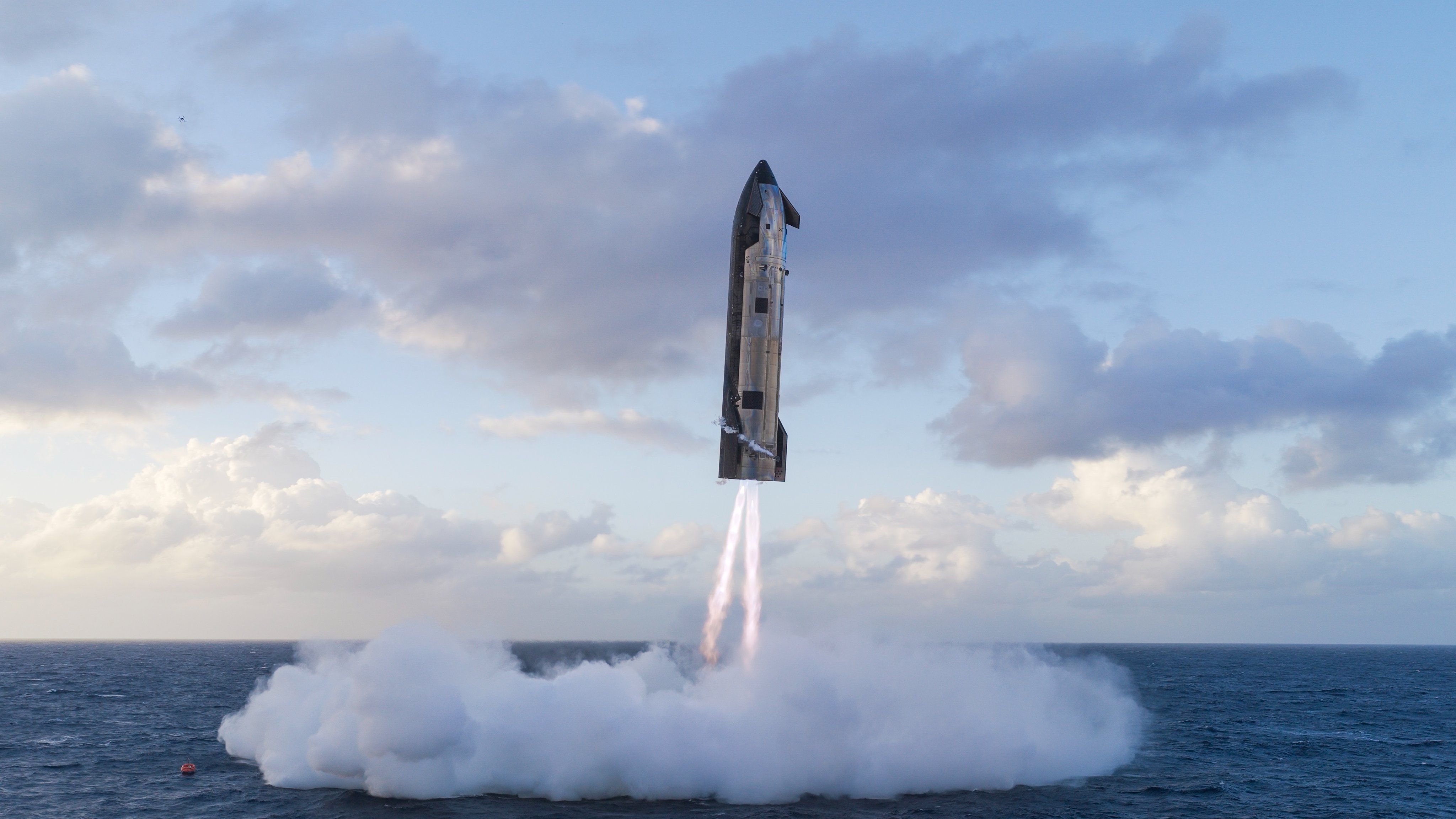
SpaceX Starship V3 under full power during its final landing burn in the Indian Ocean. Credit: SpaceX.
SpaceX, Elon Musk's space and satellite company, is expected to go public in June 2026 on the Nasdaq stock exchange under the ticker SPCX1. The company is targeting a value of roughly $1.75 trillion and aims to raise somewhere in the ballpark of $75 billion1. If it hits those numbers, it will be the largest initial public offering (IPO) the world has ever seen, nearly three times the size of the previous record holder, Saudi Aramco.
One note to consider before we proceed. A few specific listing dates have been erroneously reported by various outlets, but none of them appear in SpaceX's official filing. The exact date is generally not locked in until the company officially prices the offering, the final step before trading begins. We stick to facts here, not rumors. By the time some of you read this, that date may have become finalized.
Our analysis uses numbers obtained directly from SpaceX's official prospectus: the mandatory SEC filing (S-1) a company submits before going public. The document is publicly available on the SEC's EDGAR database, and we reviewed it in detail. That is our approach: when a company tells its story, we verify it against the primary regulatory paperwork.
Welcome to Orbital Intel, presented by Defense Briefing. Every Wednesday, you receive the week's defense, aerospace and space economy signal in plain language. Primary sources. No hype. Built for analysts, operators and the curious.
Today's headlines are rarely new. They're sequels. We deliver the prequels.
Here's what the paperwork actually reveals: SpaceX isn't one company, but rather three powerful businesses operating under a single ticker.
First and foremost is the space segment: the undisputed backbone of the U.S. space program. It reliably launches astronauts, military payloads and government satellites at an unmatched cadence and it is the business most people associate with SpaceX.
The company's space segment continues to impress, with its dominance recently underscored by Starship's twelfth test flight, shortly after releasing the prospectus. This mission debuted the upgraded Starship and Super Heavy V3 vehicles, together making the most powerful rocket system ever built and powered by next-generation Raptor 3 engines. The launch also took place from a brand-new, modernized tower at Starbase in Texas.
Although SpaceX is associated with its rockets and space segment, its financial engine is currently powered by its Connectivity segment. As the company's most lucrative core business, this sector powers global internet access for everyday consumers via Starlink and also delivers secure communications for government and national security agencies through its Starshield division.
The Connectivity segment's numbers in the prospectus are not subtle. It brought in $11.39 billion in revenue in 2025, up 49.8% in a year2. The division accounted for 61% of all SpaceX revenue last year, and that share climbed to 69% in the first quarter of 20262. Its income from operations, the profit left after running costs, was $4.42 billion, up 120.4% year-over-year2.
Put plainly: the satellite business is not a side hustle. It is the backbone of the company at the moment, and it is already very profitable. And it is growing. That is the bull case and it is not hype.
Rounding out SpaceX's portfolio is the AI segment, with xAI joining the lineup in February 2026 through an all-stock merger3, bringing with it the Grok AI chatbot and the social media ecosystem of X, formerly Twitter.

Onboard image from Starship and Super Heavy V3. The upgraded cameras on the booster delivered uninterrupted 4K video streams across the full flight via Starlink. Credit: SpaceX.
But what about those screaming headlines claiming a $4.94 billion loss? Simple: that figure represents the entire combined company, including the xAI merger. The Connectivity segment is firing on all cylinders, exactly as the bull case predicted, while the rocket business keeps reliably delivering for NASA and the Pentagon. The red ink is overwhelmingly coming from the aggressive, cash-hungry AI buildout.
Both numbers are accurate. The Connectivity segment is the profitable, fast-growing glue holding everything together, while the AI segment is burning cash exactly like its peers at Anthropic, OpenAI and others. They simply reflect two different realities sharing the same ticker: a highly profitable core business versus the aggressive investment cost of building a young AI powerhouse at full sprint.
Investors who truly understand this split are already lapping the rest of the market. That's exactly why Defense Briefing exists.
There is one additional figure in the prospectus that demands our rigorous scrutiny. SpaceX asserts it faces the largest addressable market in human history: a staggering $28.5 trillion4, with some $26.5 trillion attributed to artificial intelligence. While that number is indeed printed on the page, we must look beneath the surface.
The vast majority of this sum ($22.7 trillion) is attributed to "enterprise applications." This is not a measure of what SpaceX is currently producing, nor is it a measure of the revenue they have captured. It is simply a tally of all business software spending across the entire globe. That is the market they are going after. Basically, everybody.
An addressable market is not an economic forecast. A market opportunity tells you only how much empty space exists in the world, waiting to be filled. It tells you absolutely nothing about a company's capacity to fill it. Pointing that out is not a knock on the company. It is just a reminder of something basic: if you don't want to get fooled by a big number, learn the difference between hard facts and convenient truths.
We're not here to tell you whether SPCX belongs in your portfolio. We're here to equip you to read the filing yourself and clearly see both sides of the business: a highly profitable space-and-satellite core that anchors American access to orbit, and a high-risk, high-ambition AI bet riding on the same ticker. That is what Defense Briefing does, every week.
Every Wednesday, you will receive one focused intelligence-style brief with four sections:
01 The Situation: What is currently happening in defense, space or military technology and why it matters.
02 The Breakdown: Complex systems and programs explained in plain English, without excessive jargon or unwarranted hype.
03 The Players: The contractors and public companies positioned to execute and profit.
04 The Angle: Clear implications for national security, capital allocation and the balance of power.
Defense Briefing delivers structured analysis at the intersection of defense, space and markets. It is written for investors, operators and serious observers who need to stay ahead of the infrastructure shaping the next decade.
Our mission is straightforward: make you early, informed and equipped to navigate the new defense landscape with clarity. The next ten years will not be defined by what appears on the evening news. They will be defined by the orbital infrastructure, data architecture and procurement decisions being locked in today, long before they reach the headlines.
This is it.
Join now. The next issue drops soon.
Sources: SpaceX's 2026 SEC registration statement and amendments, company mission materials and the financial and market disclosures cited below. No classified information was used and all material is publicly accessible.