
Golden Dome Funding Faces a $60B Reconciliation Squeeze
The administration wants $17.12 billion for the Golden Dome for America Fund next year. Almost all of it rides on a reconciliation bill Congress has only begun to write, and Golden Dome is not yet a line in it.
LIVE STATUS, 22-JUL-2026: the House adopted H. Con. Res. 113 by 216-214 (Roll Call 281). The Senate has not agreed to the resolution, so reconciliation protections have not yet attached.
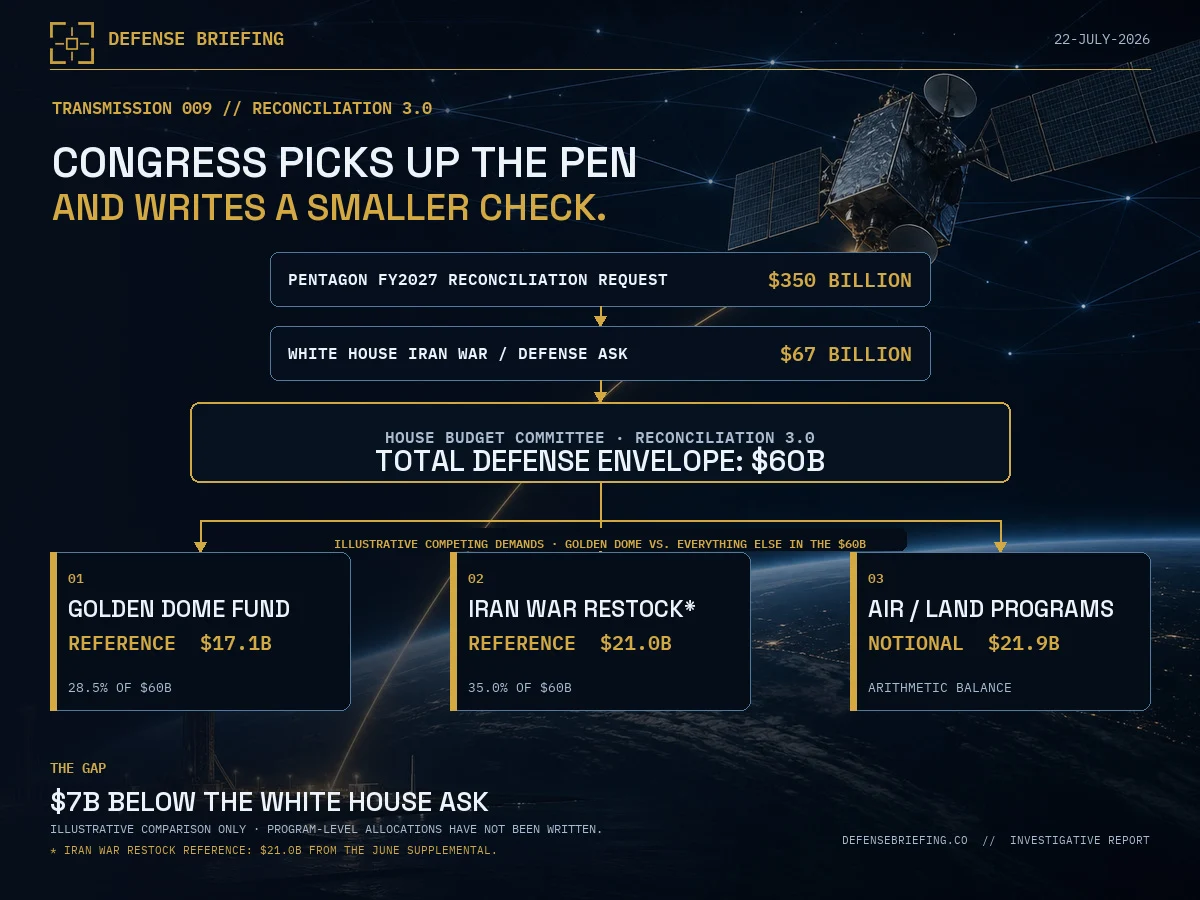
The request narrows at each stage of the process. The three cards inside the $60 billion envelope are illustrative competing demands; program-level allocations have not been written. Graphic: Defense Briefing. Data: White House FY2027 budget appendix and OMB supplemental request.
The administration's fiscal 2027 budget asks for $17.12 billion for the Golden Dome for America Fund, and about 98 percent of it depends on legislation Congress has only begun to write. On 16-JUL-2026 the House Budget Committee advanced that legislation's framework; it hands the House Armed Services Committee (HASC) a defense instruction worth roughly $60 billion, but it does not name a single program.1,2,3
Fund Golden Dome in full and it would equal about 28.5 percent of that instruction's headline amount, before Congress pays for munitions, operational costs, readiness or any other modernization priority. That is the squeeze. This request is also separate from the roughly $24.4 billion Congress enacted in the 2025 reconciliation law for integrated air and missile defense activities. Congressional materials associated that funding with Golden Dome, although the statute itself did not use the name.8
Reconciliation 3.0 in 30 Seconds
- • Budget reconciliation lets a Senate majority advance legislation affecting spending, revenue or the debt limit without the usual 60-vote cloture threshold.
- • This is Congress's third reconciliation effort this cycle, after the July 2025 One Big Beautiful Bill Act ($150 billion for defense) and the June 2026 Secure America Act (about $70 billion for border and immigration enforcement).
- • On 16-JUL-2026 the House Budget Committee advanced the FY2027 budget resolution, H. Con. Res. 113, by a party-line 20-14 vote. Its instructions permit roughly $60 billion for Armed Services, $13 billion for Intelligence, $12 billion for Agriculture and $10 billion for House Administration.
- • The resolution sets committee instructions, not program line items. The instructed committees have until 11-SEP-2026 to submit legislative recommendations.
- • Golden Dome's exposure: the administration proposes $17.12 billion in FY2027 mandatory funding for the program, while the House defense instruction totals about $60 billion.
Card sources: 1 House Budget Committee vote release; 2 H. Con. Res. 113 Rules Committee print; 3 FY2027 defense budget appendix; 4 DoD mandatory-funding overview; 5 Secure America Act signing statement; 6 CBO estimate for S. 2.
The Request, in Full
The administration's fiscal 2027 budget proposes $17.12 billion in mandatory funding for the Golden Dome for America Fund: $13.824 billion for research and development, $2.147 billion for procurement and $1.149 billion for operations and maintenance. The House's regular defense appropriations bill, by contrast, includes $397.971 million for the fund. Together the two tracks amount to roughly $17.52 billion, with about 98 percent dependent on legislation outside the regular discretionary bill.3,7
The next funding vehicle is taking shape, but Golden Dome is not yet a line item. On 16-JUL-2026 the House Budget Committee approved H. Con. Res. 113 by 20-14, and the full House adopted it on 22-JUL-2026 by 216-214. The resolution instructs HASC to recommend legislation increasing the deficit by no more than roughly $60 billion across fiscal years 2027 through 2036; it does not specify which defense programs receive the money.1,2,25
If HASC supplied the full $17.12 billion mandatory request, Golden Dome would equal about 28.5 percent of that instruction's headline amount. Treat that as an illustrative comparison rather than a budget score. The $60 billion is a ceiling on the legislation's ten-year deficit increase, while the $17.12 billion is requested budget authority; the share actually consumed will depend on spending timing, offsets and the eventual congressional score.
Follow the money before the markup does. Get every transmission free.
Subscribe to Orbital IntelHow Reconciliation 3.0 Could Fund Golden Dome
Reconciliation begins with a budget resolution. That resolution instructs committees to recommend changes in spending or revenue; it does not itself provide program funding. The House and Senate must agree to the same budget resolution before the expedited process can move forward.9
H. Con. Res. 113 directs four House committees to submit recommendations by 11-SEP-2026: Armed Services, roughly $60 billion; Intelligence, roughly $13 billion; Agriculture, $12 billion; and House Administration, $10 billion. Those are ceilings, not awards. Statements describing the buckets as funding for Iran-related military costs, agriculture assistance or election administration reflect the proposal's stated policy purposes; they do not assign dollars to named defense programs.
For Golden Dome, the central question is therefore narrower than the headline number: Will HASC's eventual legislative text name the Golden Dome for America Fund, and will it provide procurement authority as well as research-and-development money?
The SAVE America Act Adds Procedural Risk
Republican leaders have linked the $10 billion House Administration instruction to election-administration provisions associated with the SAVE America Act, including state implementation of citizenship-verification and voter-identification requirements. That linkage may help assemble House votes, but it also creates Senate risk.
Reconciliation legislation is subject to the Byrd Rule, which bars provisions considered extraneous to the budget. A provision can be vulnerable when its budgetary effect is merely incidental to its nonbudgetary policy. The election language could therefore face a Byrd Rule challenge once legislative text exists. That outcome is not predetermined: the Senate parliamentarian advises on procedure, senators raise points of order and the presiding officer rules.10,11
Defense spending is more likely to satisfy the rule's budgetary tests than election-policy mandates. The political risk is indirect: if the election provisions are narrowed or removed, the House coalition for the larger package could change, delaying the vehicle carrying Golden Dome's request.
What Is the Byrd Rule in 30 Seconds?
- • The Byrd Rule limits what the Senate may include in reconciliation legislation.
- • It identifies six categories of "extraneous" matter, including provisions with no budget effect and provisions whose budget effect is merely incidental to a larger policy change.
- • Before floor action, Senate offices and the parliamentarian commonly review provisions in an informal "Byrd bath." The parliamentarian advises; senators enforce the rule by raising points of order.
- • If the presiding officer sustains a Byrd Rule point of order, the challenged language is struck. Waiving the rule requires three-fifths of the Senate: 60 senators when no seats are vacant.
- • The SAVE America Act provisions may be vulnerable if their spending effects are judged incidental to their election-policy requirements. That judgment cannot be made reliably until legislative text and budget estimates are available.
Card sources: 10 2 U.S.C. § 644; 11 Congressional Research Service, Byrd Rule.
Golden Dome's $17.12B Request Meets a $60B Cap
The administration's broader fiscal 2027 proposal sought about $350 billion in mandatory defense funding. The House resolution's roughly $60 billion Armed Services instruction is about 83 percent below that proposal, although the Intelligence Committee receives a separate instruction of roughly $13 billion.
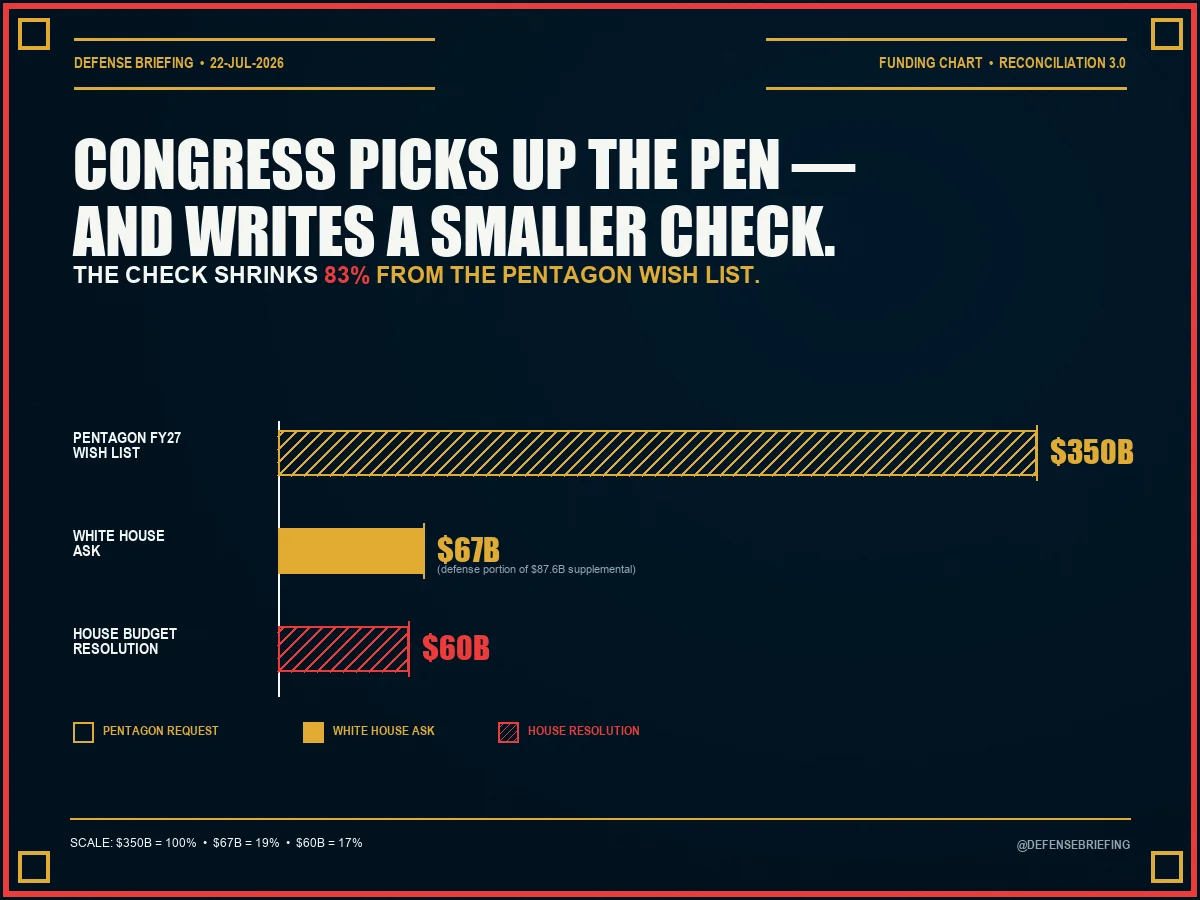
The check shrinks about 83 percent from the Pentagon request. The $67 billion figure is the defense portion of an $87.6 billion supplemental. Graphic: Defense Briefing. Data: White House FY2027 budget and OMB supplemental request.
The 24-JUN-2026 supplemental request shows the scale of the competing demands. The White House requested $87.596 billion overall, including $67.146 billion for defense. The defense request included $21 billion for munitions; $17.3 billion for operational costs; $5.1 billion for cyber and autonomous systems; $4 billion for airborne moving-target indication and a space data backbone; $2.4 billion for drones; $1.7 billion for readiness; and $12.1 billion for other classified activities.12
The supplemental and reconciliation are separate vehicles, and the House resolution does not reproduce the supplemental's categories. Still, the comparison is instructive. Munitions and operational costs alone total $38.3 billion, nearly two-thirds of the HASC instruction. Adding the full Golden Dome request would bring those three demands to $55.42 billion, before readiness, drones, cyber or other modernization accounts.
"The testable question is no longer whether Congress has opened a defense funding lane; it is whether Golden Dome receives a named share of it."
Sensors and Interceptors Advance on Separate Tracks
On 14-JUL-2026 the Space Development Agency (SDA) awarded two firm-fixed-price prototype agreements with a combined potential value of about $1.75 billion for 36 Accelerated Missile Defense Tranche 3 satellites. L3Harris received a $955 million agreement for 18 missile-defense variants; Sierra Space received a $798 million agreement for 18 missile-warning and missile-tracking variants. SDA says the satellites are to be ready for launch by the end of 2028.13
Two days later, a Falcon 9 launched 21 Tranche 1 Transport Layer spacecraft for SDA. The data-relay satellites are intended to provide secure, low-latency links supporting the tracking of advanced missile threats.14
Sensors and communications links, however, do not perform the intercept. Space Systems Command (SSC) announced in December that the Space-Based Interceptor (SBI) program had awarded 20 prototype agreements to 12 companies, with a combined potential value of up to $3.2 billion, to demonstrate an initial capability integrated with Golden Dome by 2028.15
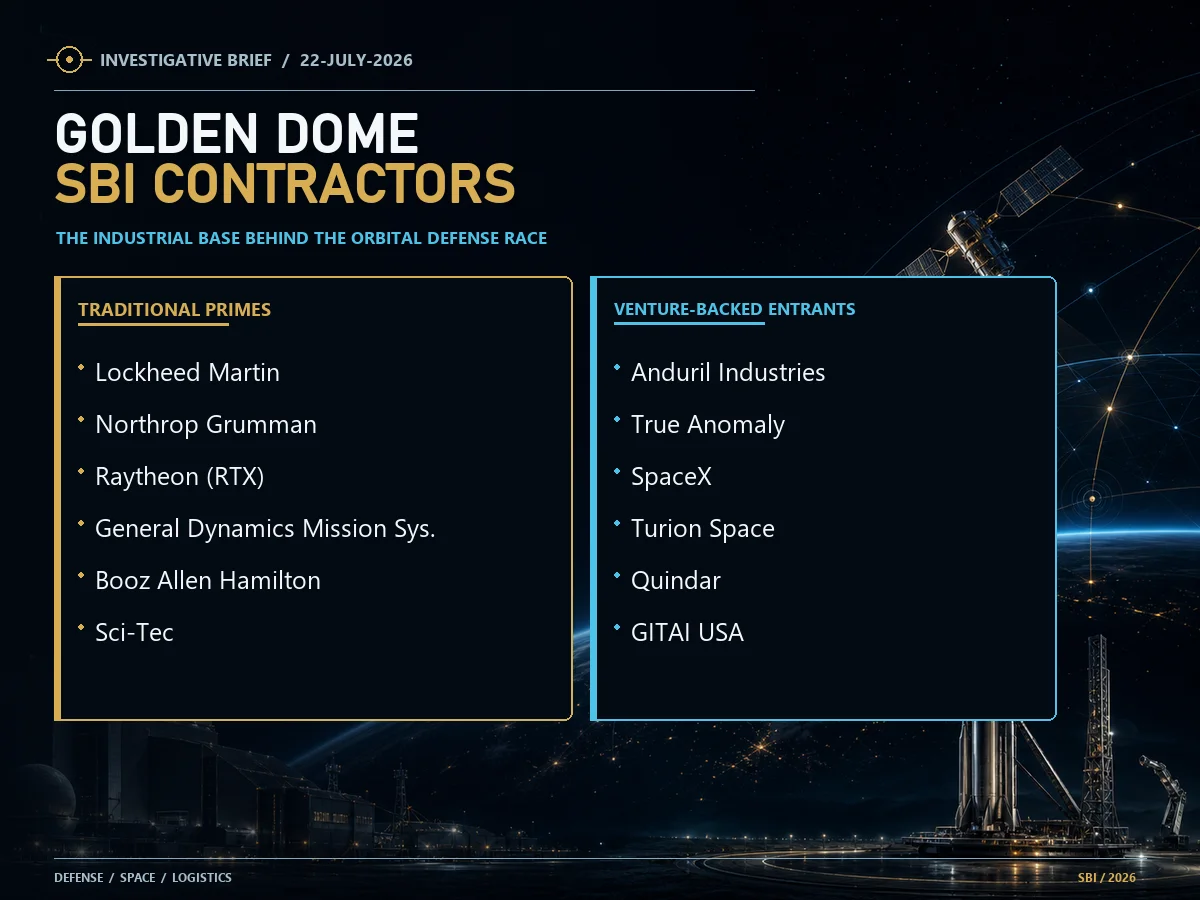
The twelve companies holding SBI prototype agreements, grouped by traditional primes and venture-backed entrants. Graphic: Defense Briefing. Data: Space Systems Command.
That record changes the funding diagnosis. Interceptor work has not stalled; it is active under prototype agreements. Nor do public budget documents assign the entire $17.12 billion Golden Dome request to space-based interceptors. The unresolved issue is scale: how much follow-on research, procurement and integration funding Congress will provide, and whether prototype work transitions into production.
Contract structure over headlines. That is the Orbital Intel edge.
Get Orbital Intel FreeQ2 Defense Lobbying Shows Breadth, Not Golden Dome Intent
Second-quarter Lobbying Disclosure Act (LD-2) filings record reported expenses, clients and issue areas. They do not prove why a company lobbied or tie an expense to a specific program unless the filing says so.
The in-house filings reviewed for this article reported $4.18 million for Lockheed Martin, $3.86 million for RTX, $3.42 million for General Dynamics and $1.70 million for Northrop Grumman. Outside lobbying firms filed separately, so those numbers are not all-in company totals. Northrop's filing expressly lists "Budget Resolution/Reconciliation" alongside fiscal 2027 defense appropriations and the National Defense Authorization Act (NDAA); the other filings cover multiple defense and government issues. None isolates Golden Dome spending.16,17,18,19
At the smaller-company end, Cornerstone Government Affairs reported $50,000 in lobbying income from True Anomaly, while Venture Government Strategies reported $60,000 from Turion Space. Those are individual registrant filings, not necessarily each client's total federal lobbying spend.20,21
The more useful investment signal is contract structure. The Space-Based Interceptor agreements fund prototype development and demonstration; their stated potential value is a ceiling, not cash already received and not a production commitment. Follow-on procurement authority, not lobbying totals, will show whether the program is crossing from demonstrations to a durable acquisition line.
Appropriators and Authorizers Are Working Different Tracks
The House fiscal 2027 defense appropriations mark provides $397.971 million for the Golden Dome for America Fund through the regular discretionary process. The administration, meanwhile, proposes $17.12 billion in mandatory funding. That split creates an oversight question without proving institutional motive: most of the requested money would travel through reconciliation rather than the annual appropriations bill.7,3
HASC must now draft inside its instruction. Two broad strategies illustrate the trade space. Operations first: prioritize munitions replenishment and current warfighting costs, increasing pressure on Golden Dome and other modernization programs. Modernization first: protect missile defense, space and autonomous systems while leaving more immediate operational costs for separate legislation. Those are analytical scenarios, not announced congressional plans. The actual allocation will not be knowable until committee text appears.
The Angle: Watch Authority, Not Just the Top Line
Three indicators will determine whether Golden Dome's current momentum becomes a funded acquisition program.
1. The House and Senate budget resolution. On 22-JUL-2026 the House adopted H. Con. Res. 113 by 216-214 on Roll Call 281, after consideration under the closed rule provided by H. Res. 1438.22 The margin ran entirely through the majority: 216 Republicans voted yes, two voted no, and they were joined in opposition by 211 Democrats and one independent, with one member not voting. That is only the first half of the step. The Senate must agree to an identical resolution before the expedited reconciliation process can proceed, and the instructed committees then write the legislative text. As of this writing the Senate had not taken up the resolution, so reconciliation protections have not attached. The House had separately passed H.R. 9770, a continuing resolution through 04-DEC-2026, by 220-205 on 21-JUL-2026; that measure does not settle the Golden Dome request.23,25,26
2. The 11-SEP-2026 recommendations. The decisive text will show whether HASC names Golden Dome and how it divides funding among research, procurement, operations and integration.
3. The transition beyond prototypes. Space-Based Interceptor work is underway, but 20 prototype agreements do not guarantee a production program. Procurement authority and funded quantities will be the clearest evidence of transition.
The framework for Reconciliation 3.0 exists. The testable question is no longer whether Congress has opened a defense funding lane, but whether Golden Dome receives a named share of it, and whether that share is structured to buy operational capability rather than another round of demonstrations.
One execution caveat frames the whole story. The Government Accountability Office (GAO) estimates that the broader Proliferated Warfighter Space Architecture (PWSA) could cost nearly $35 billion through fiscal 2029 and identifies schedule, technology-readiness and cost-estimating weaknesses. That finding supports caution when translating award announcements into fielded capability.24
Forward this to the analyst who still thinks a $60 billion instruction is a Golden Dome check.
Sources: White House FY2027 defense budget appendix; House FY2027 defense subcommittee mark; House Budget Committee release and H. Con. Res. 113 Rules Committee print; Congressional Research Service (2025 reconciliation funding and Byrd Rule); DoD mandatory-funding overview; White House Secure America Act signing statement; Congressional Budget Office estimate for S. 2; 2 U.S.C. sections 641 and 644; OMB 24-JUN-2026 supplemental request; Space Development Agency and Space Systems Command releases; Senate Lobbying Disclosure Act filings for Lockheed Martin, RTX, General Dynamics, Northrop Grumman, True Anomaly and Turion Space; House floor schedule and House Clerk roll call; GAO-26-107085. No classified information was used and all material is publicly accessible.