
The Prize Fight: Golden Dome's Interceptor Layer Goes to Auction
Twelve companies, 20 prototype agreements and up to $3.2 billion on the table. It is the same strategic dream President Reagan pitched in 1983 with one variable changed: getting to space is now cheaper. Congress remains the one obstacle nobody knows how to engineer.
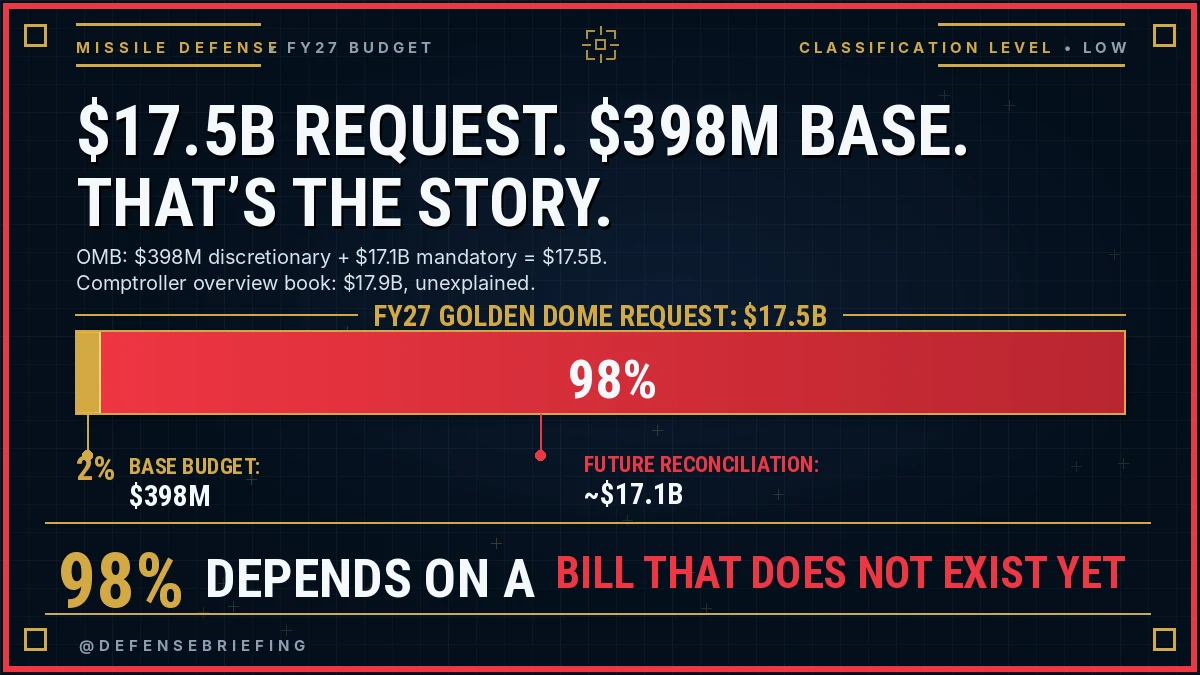
The fiscal 2027 Golden Dome request in one bar: $398 million in the base budget, $17.1 billion riding on a reconciliation bill that has not been written. Graphic: Defense Briefing. Data: OMB FY27 Budget Appendix.
Forty-three years ago, Ronald Reagan asked Americans to imagine a shield over the country. The pitch was simple: knock nuclear missiles out of the sky before they can reach American soil. His 23-MAR-1983 address launched the Strategic Defense Initiative (SDI), which critics quickly branded Star Wars. Washington spent roughly $30 billion on the concept over the next decade and put exactly zero operational interceptors in orbit. In 1993 the Pentagon boxed up the space weapons work; Defense Secretary Les Aspin called it taking the stars out of Star Wars.
The Pentagon wants a rematch.
The Space Force has awarded 20 Other Transaction Authority (OTA) agreements worth up to a combined $3.2 billion to 12 companies to prototype space-based interceptors for Golden Dome.1 The roster mixes legacy heavyweights with venture-backed upstarts: Anduril, Booz Allen Hamilton, General Dynamics Mission Systems, GITAI USA, Lockheed Martin, Northrop Grumman, Quindar, Raytheon, Sci-Tec, SpaceX, True Anomaly and Turion Space.1 They have until roughly 2028 to demonstrate hardware worthy of integration into the architecture.1
Welcome to Orbital Intel, presented by Defense Briefing. Every Wednesday, you receive the week's defense, aerospace and space economy signal in plain language. Primary sources. No hype. Built for analysts, operators and the curious.
Today's headlines are rarely new. They're sequels. We deliver the prequels.
THE SBI PRIZE FIGHT IN 30 SECONDS
- • 20 OTA prototype agreements, up to $3.2 billion combined, awarded to 12 companies between late 2025 and early 2026
- • Space-based interceptors (SBIs) are orbital kill vehicles designed to destroy missiles in boost, midcourse and glide phases
- • Prototype demonstration and integration into Golden Dome targeted around 2028
- • The Pentagon pegs Golden Dome at $185 billion over roughly 10 years; CBO's notional 20-year architecture runs near $1.2 trillion
- • Only $398 million of the $17.5 billion FY27 request sits in the base budget; the rest depends on a future reconciliation bill
A Bake-Off, Not a Program of Record
Note the structure. The Pentagon is not handing one prime contractor a three-decade program of record. This is a bake-off. The Space Force is using the prototypes to test competing designs before it decides who builds the constellation.1 Twelve enter. Far fewer leave with production contracts.
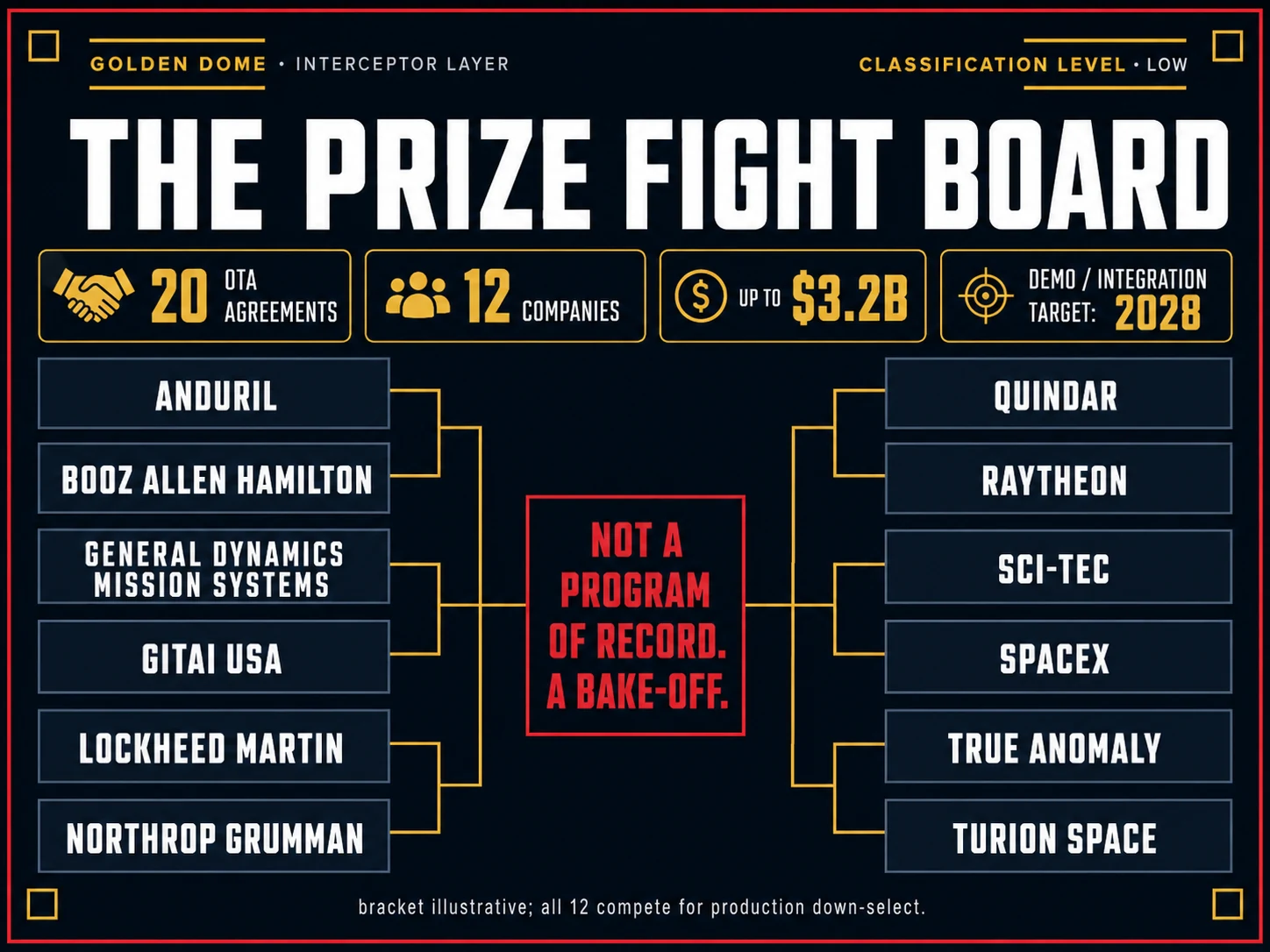
The 12 OTA holders. Bracket illustrative; all 12 compete for the production down-select. Graphic: Defense Briefing. Data: Space Systems Command, 24-APR-2026.
The factions formed early.
Northrop Grumman paired with Apex, a startup built to mass-produce satellite buses.2 Raytheon teamed with Rocket Lab.2 Anduril assembled a bench of Impulse Space, Inversion Space, K2 Space, Sandia National Laboratories and Voyager Technologies.3 The pattern is consistent: the old guard brings the kill vehicles, the sensors and the classified-program discipline; the newcomers bring assembly-line tempo. It is a structural inversion of the 1990s defense consolidation. The primes are renting commercial production speed because the hard question is no longer whether an interceptor can hit a target in the cold dark. It is whether anyone can build, launch and replace thousands of them without breaking the budget.
Gen. Michael Guetlein, who oversees Golden Dome, has drawn that line himself, telling lawmakers that if the Pentagon cannot do boost-phase interceptors affordably, it will not take them into production.4 That is not a bureaucratic footnote. That is the entire ball game.
Primary-source defense and space intelligence, every Wednesday. No hype, no paywall.
Get Orbital Intel FreeThe Physics Improved. The Bottleneck Moved.
The engineering case is stronger than it was in 1983, and not because missile defense got easier. Launch stopped being the dominant bottleneck. In its May 2026 cost model, the Congressional Budget Office (CBO) assumed launch prices of $500 per kilogram to low Earth orbit (LEO), a rate below today's typical prices but considered achievable with Starship-class heavy-lift rockets. At that price, launch accounts for less than 5 percent of the total bill.5 Launch is no longer the bottleneck. Building interceptors that work, at scale, is.
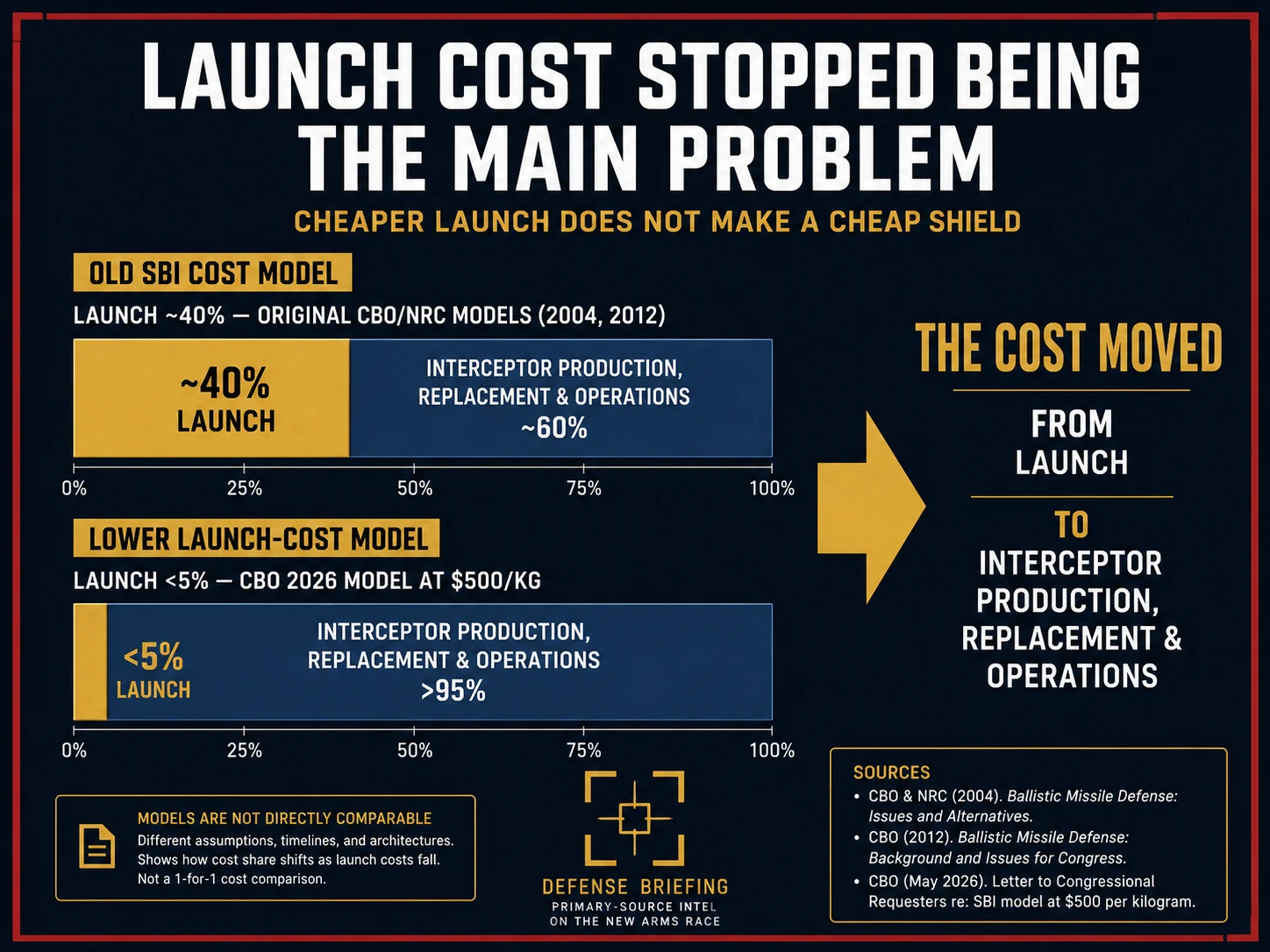
Cheaper launch does not make a cheap shield: the cost moved from launch to interceptor production, replacement and operations. Models are not directly comparable. Graphic: Defense Briefing. Data: CBO and NRC (2004, 2012); CBO May 2026 model.
The $17.1 Billion IOU
Then you look at the funding, which is where the completion risk actually lives. Golden Dome has real money today: roughly $25 billion in the 2025 reconciliation package6 and about $13.4 billion for space and missile defense systems in the fiscal year 2026 defense appropriations bill enacted 03-FEB-2026.7 The warning light is fiscal 2027. The Pentagon is requesting $17.5 billion for Golden Dome. Only $398 million of that sits in the base budget. The rest hinges on a future reconciliation package that does not exist yet.8
Let that number percolate. Nearly 98 percent of next year's Golden Dome request depends on a bill Congress has not written, let alone passed.
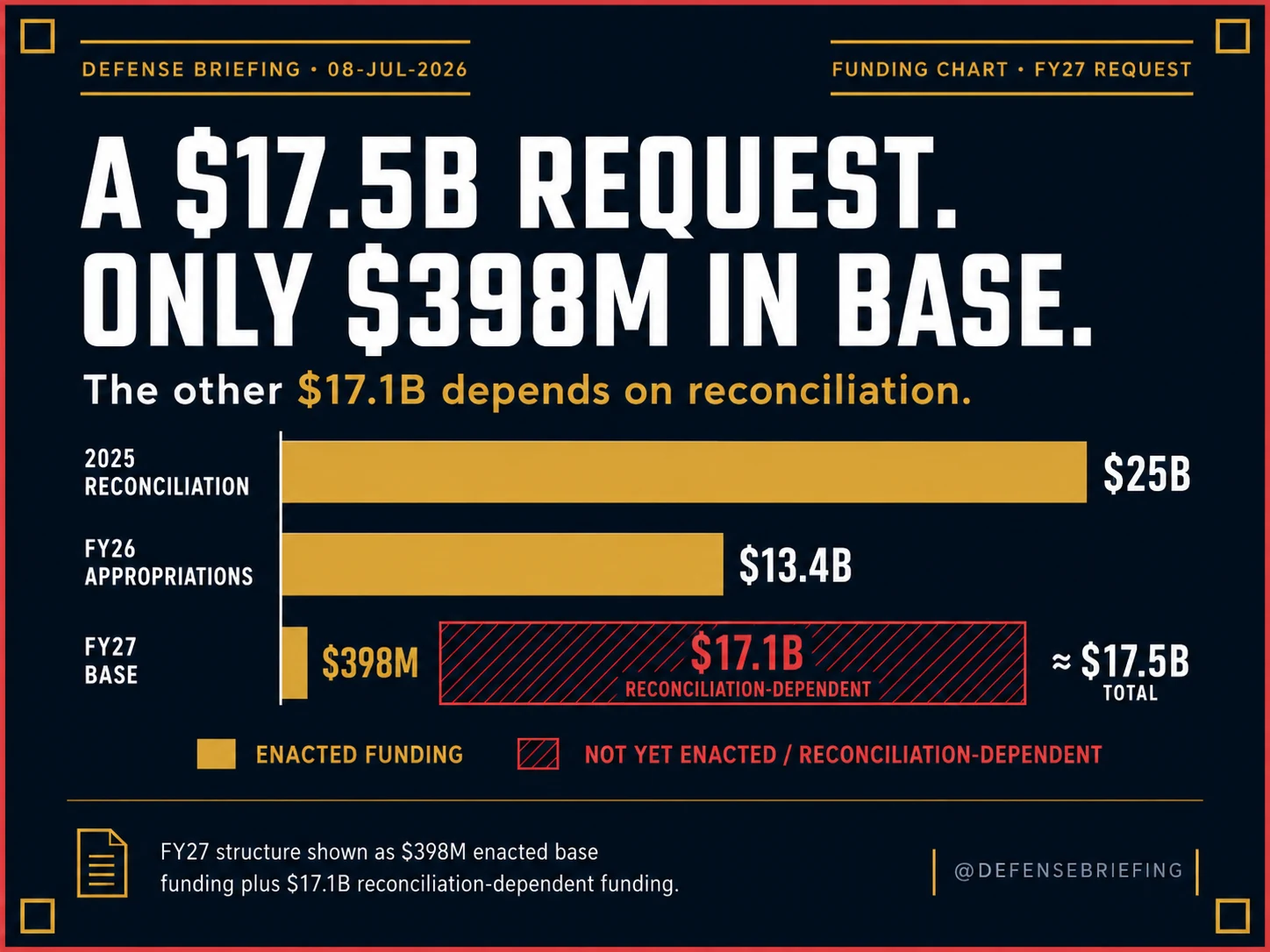
Golden Dome's funding trajectory: solid bars are enacted; the hatched segment is not. Graphic: Defense Briefing. Data: P.L. 119-21, FY26 defense appropriations, OMB FY27 Budget Appendix.
That is not normal budget plumbing. That is political risk strapped directly to a national defense architecture. Reconciliation works when one party runs the table in Washington; the mechanism vanishes the moment the math changes. The program is being marketed as a permanent shield and funded like a one-Congress opportunity. For calibration, SDI ran through ordinary appropriations at about 1.3 percent of total Department of Defense spending from fiscal 1986 through fiscal 1990 and still did not survive a change of administration.9
"Nearly 98 percent of next year's Golden Dome request depends on a bill Congress has not written, let alone passed."
$185 Billion vs $1.2 Trillion: Two Different Constellations
Then there is the scale of the cost, and the numbers do not agree with each other.
Guetlein has said the system will stay within $185 billion, a figure that covers roughly the next 10 years.10 CBO's 12-MAY-2026 estimate of a notional national missile defense architecture built to the executive order's stated objectives came in near $1.2 trillion over 20 years, roughly $60 billion annually.5 An independent analysis from the American Enterprise Institute has put a robust version of the architecture as high as $3.6 trillion over 20 years including operations, maintenance and replenishment.10 The space-based layer is the main driver. CBO modeled 7,800 interceptors in near-polar LEO with a five-year service life, which means building and flying nearly 1,600 replacements every single year at an average of $22 million per satellite. That layer alone accounts for $743 billion, roughly 60 percent of the total.5
And even that constellation is sized to engage a raid of just 10 intercontinental ballistic missiles launched nearly simultaneously.5 A larger salvo from a peer arsenal overwhelms it with arithmetic, not by trickery. CBO itself flagged the gap between its figure and the Pentagon's: either the objective architecture is far more limited than the executive order describes, or significant costs will be carried in other budget accounts, or both.5 The distance between $185 billion and $1.2 trillion is not a rounding error. It is two different constellations, and nobody outside the program knows which one is being bought.
Why It Matters for National Security
Hitting a missile in boost phase is sound engineering. The target is climbing, burning hot and nearly impossible to hide, and it is destroyed before warheads and decoys separate. That solves the discrimination problem that limits today's ground-based midcourse interceptors. But a space shield is a treadmill you cannot step off. A five-year satellite lifespan locks the country into a permanent rebuild cycle; buying roughly 1,600 new interceptors a year is not a procurement program, it is a standing industrial commitment. You do not just build it. You feed it, though unit costs should fall as production matures.
Why It Matters for Capital
Three signals to watch. No recommendations, just the scoreboard.
The cut. Twelve companies hold prototype money. Most will not build the constellation. The demonstration milestones between now and 2028 are the only scoreboard that matters.
The replacement economics. If CBO's five-year lifespan holds, recurring satellite production is where the volume lives. That makes the commercial manufacturing side of these partnerships, the Apex and Rocket Lab and K2 Space tier, more consequential over time than the headline development awards.
The funding mechanism. Anyone pricing Golden Dome backlog needs to price reconciliation risk with it. The $398 million base-budget figure is the single most important number in this story. Watch how contract winners characterize this revenue on earnings calls; treatment of the reconciliation dependency is a direct test of management candor.
Know someone pricing defense backlog? This is the briefing they need before earnings season.
Subscribe FreeThe Angle
Reagan's shield failed on three fronts: the technology was immature, the cost was prohibitive and the political will evaporated. Golden Dome changes exactly one variable: cheaper launch. It does not fix the economics of building interceptors. It does not fix the five-year replacement treadmill. And it does not fix Congress.
Twelve companies are betting this becomes a real market. The fiscal 2027 budget structure says that market survives one reconciliation vote at a time.
Forward this to your portfolio manager before they price Golden Dome backlog as guaranteed.
Sources: Space Systems Command space-based interceptor OTA announcement via DefenseScoop, Northrop Grumman and SpaceNews on the Apex and Rocket Lab pairings, Anduril team announcement via SpaceNews and Via Satellite, CBO report Potential Costs of a National Missile Defense System (12-MAY-2026), CBO letter on space-based interceptor launch costs (05-MAY-2025), Public Law 119-21, fiscal 2026 defense appropriations act, OMB FY27 Budget Appendix via SpacePolicyOnline, Aerospace Corporation Center for Space Policy and Strategy FY26 Budget Brief, Defense One and Federal News Network hearing coverage. No classified information was used and all material is publicly accessible.