
China Caught a Rocket. Now Comes the Replenishment Race.
One recovered booster does not erase SpaceX's ten-year lead. It does show Beijing pursuing reusable launch capacity while Chinese and Russian researchers study how to disrupt the satellite networks U.S. forces rely on.
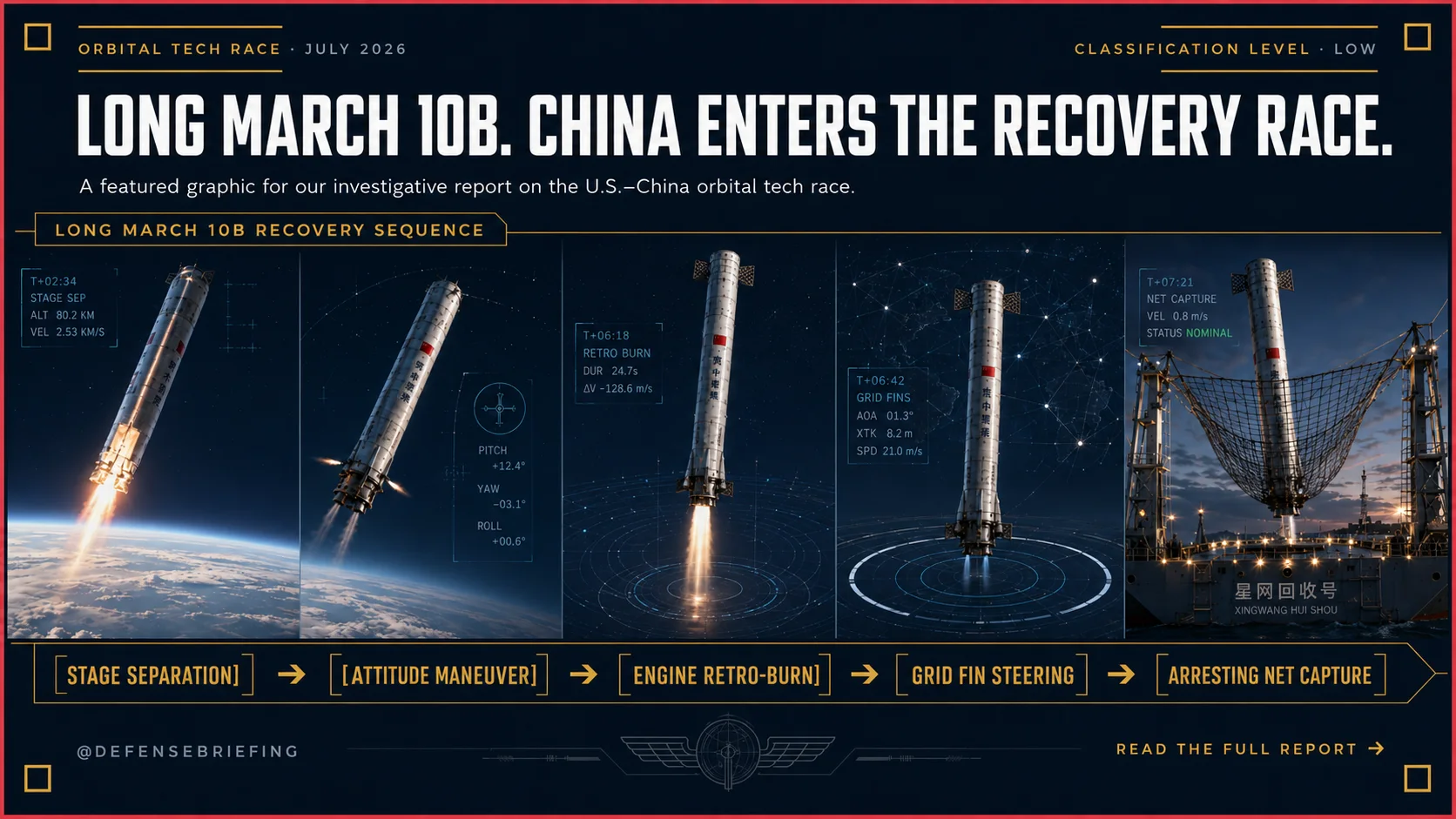
Long March 10B recovery sequence: stage separation, attitude maneuver, engine retro-burn, grid-fin steering and arresting-net capture. Graphic: Defense Briefing
At 5:25 a.m. EST on 09-JUL-2026, SpaceX launched Falcon 9 booster B1067 for a record 36th time. Eight minutes later, it touched down on the drone ship: A Shortfall of Gravitas, marking SpaceX's 617th successful booster landing. The mission pushed SpaceX's public operational totals to 663 completed missions, 617 landings and 582 reflights.3
Roughly 19 hours later, a Long March 10B lifted off from the Wenchang commercial spaceport on Hainan Island. Its first stage separated two and a half minutes into flight, reversed direction and began a powered descent. Six minutes later, four hooks on the booster engaged a high-tension cable net aboard the recovery vessel: Linghang Zhe ("Navigator").1
One event showed a mature industrial machine repeating an operational routine it has performed hundreds of times. The other showed a state-backed challenger entering the orbital-booster recovery race. China is now the second country to recover an orbital-class booster.15
Welcome to Orbital Intel, presented by Defense Briefing. Every Wednesday, you receive the week's defense, aerospace and space economy signal in plain language. Primary sources. No hype. Built for analysts, operators and the curious.
Today's headlines are rarely new. They're sequels. We deliver the prequels.
Defining the Milestone
To understand the event, we must define the recovery of an orbital-class booster. These vehicles propel a payload toward orbital velocity, not merely across the boundary of space on a suborbital arc.
Only three entities have successfully recovered an orbital-class booster stage.
ORBITAL-BOOSTER RECOVERY IN 30 SECONDS
- • An orbital-class booster recovery means bringing the first stage of a rocket that sent a payload toward orbit back intact and under control. Suborbital trajectories, exemplified by Blue Origin's 2015 New Shepard mission, do not qualify.
- • First recovery: SpaceX's Falcon 9, 21-DEC-2015, on land at Cape Canaveral. First drone ship recovery followed on 08-APR-2016.
- • Second organization: Blue Origin, whose New Glenn first stage landed on the vessel Jacklyn on 13-NOV-2025, on the rocket's second flight.5
- • Second country: China, whose Long March 10B first stage was caught at sea on 10-JUL-2026.1
- • Recovery is not reuse. The economic payoff arrives only when a recovered stage flies again, repeatedly and cheaply.
Between the two recovery flights, a joint investigation by The Insider, Der Spiegel and Le Monde reported that Chinese and Russian researchers had discussed how to restrict, jam, compromise and eventually destroy Starlink. The reporting drew from slides presented at a 2023 China-Russia military-technical forum. The slides do not prove that China's rocket and counterspace programs operate under one coordinated plan. They do expose the same strategic equation: Beijing is developing the capacity to place and replace spacecraft in orbit while researchers study how to degrade an adversary's network once it is there.4
The Net Is the Landing Gear
The Long March 10B is a two-stage commercial rocket developed by the China Academy of Launch Vehicle Technology, part of the state-owned China Aerospace Science and Technology Corporation (CASC). Chinese reports put its diameter at 5 meters (16.4 feet), liftoff thrust near 890 metric tons (981 short tons) and reusable low-Earth orbit (LEO) payload capacity at 16 metric tons (17.6 short tons). These figures come solely from Chinese state and program-linked sources and remain unverified.2
The return sequence uses familiar physics with a distinct recovery architecture.
After stage separation, the booster coasts, changes attitude and relights its engines to reduce speed. Grid fins provide aerodynamic steering while cold-gas control systems manage orientation. Instead of extending landing legs and touching down on a ship, the Long March 10B flies into a cross-shaped arresting net.12
Four light detection and ranging (LiDAR) units mounted around the platform track the rocket's position. Cables shift to enlarge the capture window, engage the onboard hooks and absorb the booster's remaining energy. The recovered stage ends the sequence hanging inside the net rather than standing on a deck. Chinese reporting describes a platform about 144 meters (472 feet) long, 50 meters (164 feet) wide and displacing 25,000 metric tons (27,558 short tons) when fully loaded.2
Think of the net as a landing gear moved to the ground. Removing the legs from the rocket cuts mass carried through launch and ascent.
A Falcon 9 booster carries landing legs through launch, ascent and staging even though it needs them only at the end of flight. China's approach transfers capture, energy absorption and post-landing stabilization to the ship. That reduces onboard complexity and reserves more mass for payload.
The system also avoids a problem that confronted early Falcon 9 operations: a tall booster standing on a moving deck can tip after landing. A suspended stage cannot fall over.
The complication is logistical. China still needs a large recovery ship, complex ocean operations, specialized crews and transportation back to port. The architecture reduces the rocket's dry mass, but it does not eliminate the steep cost of sea recovery.
The launch race is becoming a logistics race. Get the next signal before the headlines catch up.
Get Orbital Intel FreeThis Was Not a Lucky Catch
The July flight was China's first completed capture, but it was not its first test.
On 11-FEB-2026, China flew a prototype from the same Long March 10 family during an abort test for the Mengzhou crew spacecraft. After the capsule separated, the rocket stage turned for descent, deployed four grid fins and completed multiple engine relights.2
At about 120 meters (394 feet) above the sea, the vehicle deployed its onboard tether equipment to simulate the final capture sequence. It briefly reached a near-hover several meters above the water before completing a controlled splashdown.2
The development path was methodical: static-fire the propulsion system, fly the descent profile, test steering and engine relights, simulate the capture and then attempt the real thing. China succeeded on the first full net-capture attempt because it did not treat the attempt as the first test.
The distinction between recovery and rapid reuse remains absolute. China proved it can bring the stage back intact. It has not proved that it can inspect, repair, certify and repeatedly fly the vehicle at an economically useful cadence. Chinese state media says the program intends to fly the recovered booster again before the end of 2026. That reflight, not the catch itself, will determine whether the milestone begins an operational program or remains an impressive demonstration.1
The Moat Is 617 to 1
SpaceX set its latest reuse record on 09-JUL-2026. China recorded its first orbital-class booster recovery on 10-JUL-2026.
The gap is 617 Falcon booster landings to one Chinese recovery. It is 36 flights of a single SpaceX booster against one Chinese stage that has not yet flown twice.13
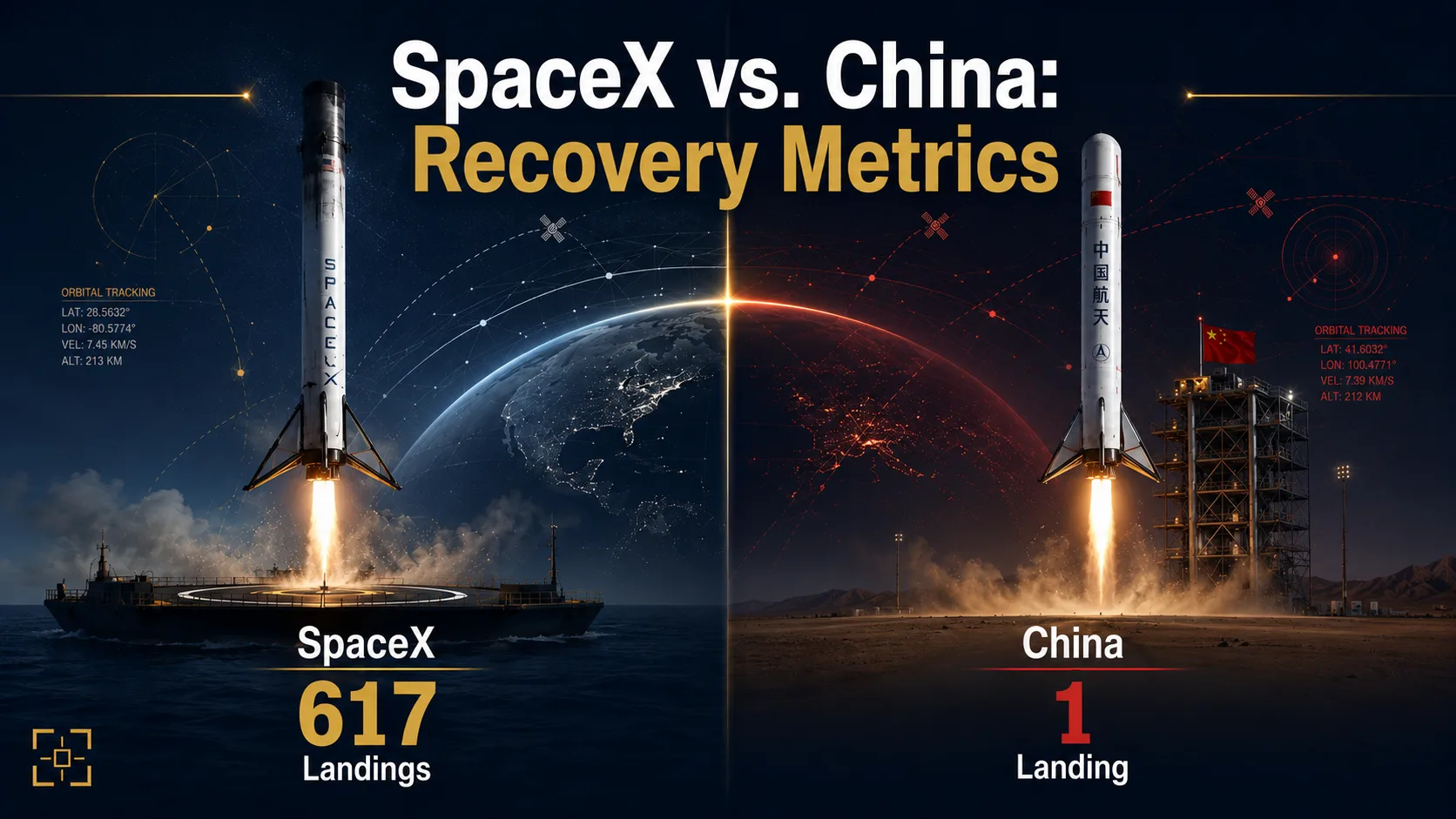
Operational snapshot: 617 Falcon booster landings compared with China's first orbital-class recovery. Graphic: Defense Briefing. Data through 10-JUL-2026.
That is the moat.
The moat is not knowing how to guide one rocket back through the atmosphere. It is the industrial system surrounding the rocket: inspection procedures, engine-life data, refurbishment teams, factories, launch pads, drone ships, regulatory approvals and customers willing to place expensive payloads on previously flown hardware.
SpaceX has converted reuse from an engineering spectacle into routine operations. The landing itself has become the least surprising part of a Falcon 9 mission. Most launches barely generate broad media coverage anymore.
Blue Origin also demonstrated orbital-booster recovery when New Glenn's second mission landed its first stage on the vessel Jacklyn on 13-NOV-2025. China was therefore not the second organization to recover an orbital-class booster. It was the second country. The distinction matters because the milestone came from China's state aerospace system, not only from one commercial company competing in isolation.5
China can move faster because the hard questions have already been answered in public. Powered descent works. Grid fins work. Sea recovery works. Recovered hardware can fly again. The development risk has shifted from proving the concept to mastering the operation.
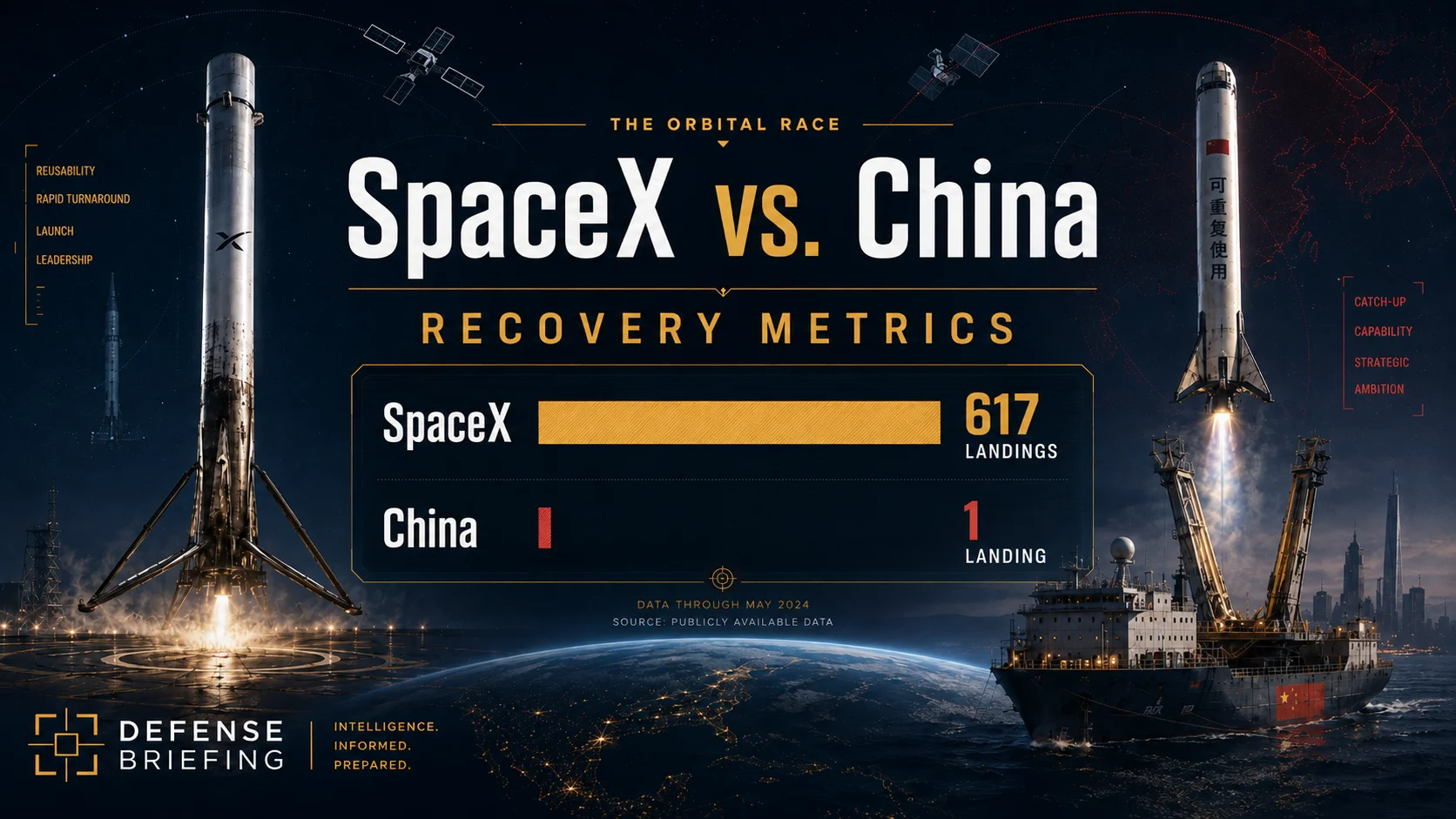
The recovery gap is not one technical trick. It is an industrial system measured in landings, reflights and turnaround. Graphic: Defense Briefing.
China does not have to recreate SpaceX's path. It can study the path, avoid dead ends and build an architecture around its own industrial priorities.
The gap between Falcon 9's first orbital-booster landing on 21-DEC-2015 and China's first recovery on 10-JUL-2026 tells only half the story. The next gap may be much shorter.
Orbital resilience is not about one rocket or one satellite. It is about the system behind them.
Subscribe FreeThe Target in Orbit
The CASC researchers identified in the Starlink slides work for the same state-owned parent organization that builds the Long March. That link does not prove the booster team works with the counterspace team. An organization chart is not an operational plan.
Their presentation did describe a three-level escalation ladder.4
The first level is political. China and Russia would lobby international bodies to protest orbital crowding, near-misses and low-Earth monopolies.
The second level is electromagnetic. They would jam signals over specific regions and fight for the same radio bands to block Starlink's expansion.
The third level is physical. The objective is not to hit one satellite. It is to destroy spacecraft faster than SpaceX can launch replacements.
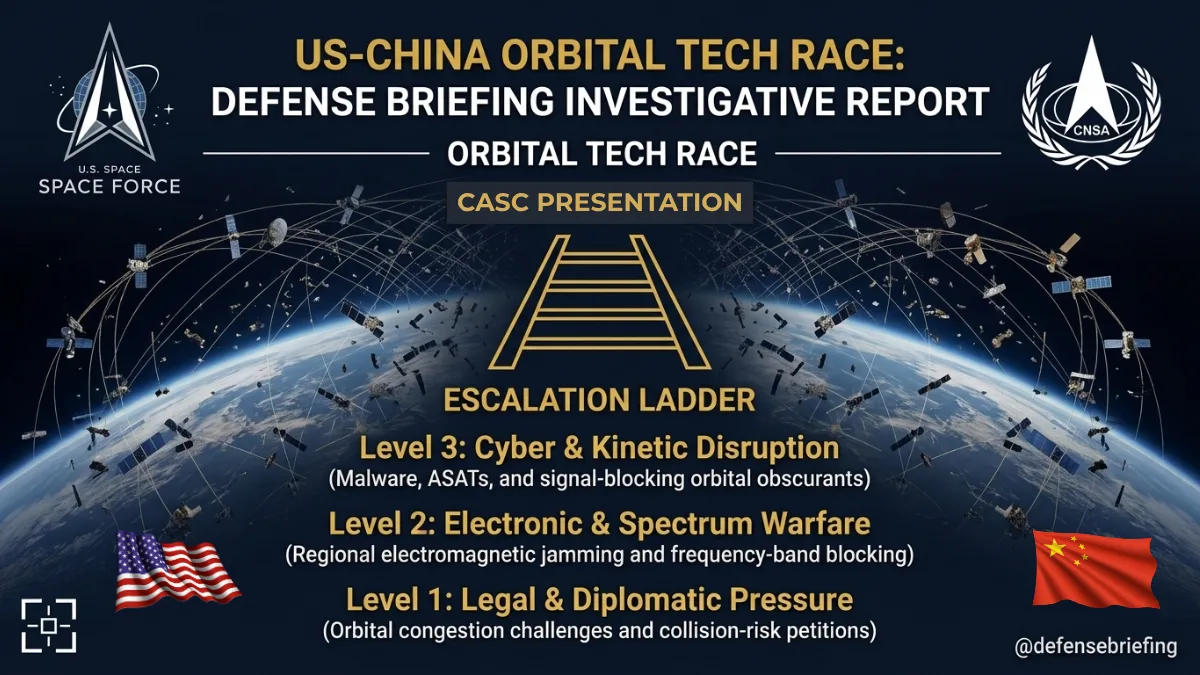
The reported escalation ladder moves from legal and diplomatic pressure to electromagnetic interference and physical disruption. Graphic: Defense Briefing, based on joint reporting by The Insider, Der Spiegel and Le Monde.
Starlink is resilient because it is distributed. Thousands of satellites circle Earth. If one is destroyed, the network can route data through other spacecraft and ground gateways.
Dependence on a single provider creates a different bottleneck. SpaceX controls the launch pads, factories, software and terminals. An adversary does not need to shoot down thousands of satellites if it can strike factories on Earth, attack launch infrastructure, corrupt software or disable ground control.
There are other ways to break the mesh. Directed-energy weapons on the ground can blind satellite sensors. Localized jamming can cut off a region. Even tactics such as releasing high-density aerosol clouds or physical debris could block the line of sight needed for optical cross-links, splitting the network into isolated pieces. The satellites could remain in orbit while the system stops functioning.4
The Replenishment Equation
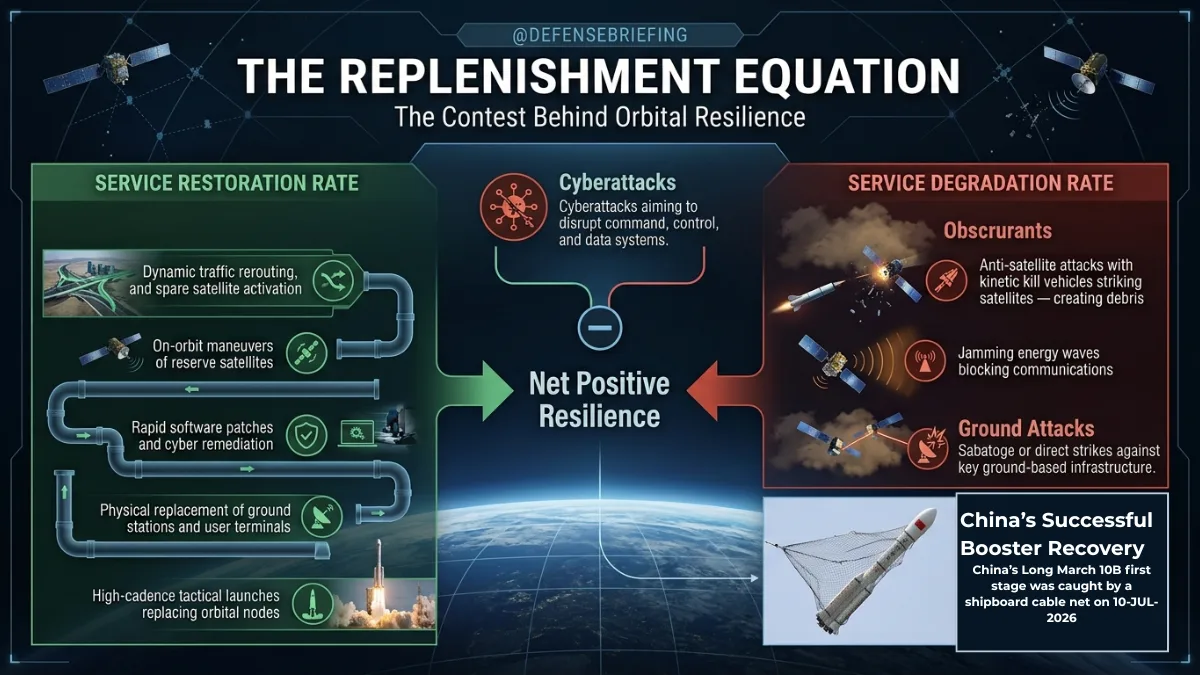
The replenishment equation: restoration rate must exceed degradation rate to keep a constellation alive. Graphic: Defense Briefing.
In orbital warfare, the key calculation is the replenishment rate.
Restoration is more than launching a new rocket. It means moving spare satellites, patching software, replacing ground terminals and routing data through new paths.
"To win, you must restore service faster than the enemy degrades it."
A highly distributed constellation tells the enemy that one successful strike does not matter. A rapid launch system tells them that even a massive strike buys only a temporary advantage.
This is why China's rocket catch matters. It is the first step toward lower-cost, high-cadence replenishment.
The Burden of the Mesh
The United States holds a wide lead in space logistics, but its military plans rely on this replenishment math.
The Space Development Agency is building a military mesh designed to take a hit. It works because it has hundreds of small nodes. That resilience fails if American factories and launch crews cannot replace satellites faster than an enemy can disable them.
The "Golden Dome" missile defense plan carries the same burden on a larger scale. Defense Briefing's earlier analysis estimated that sustaining the proposed architecture could require launching roughly 1,600 replacement satellites each year. Cheap rockets do not make the system cheap. They move the bottleneck to factories, payload integration and launch crews.6
A reusable Chinese rocket gives Beijing two additional options:
- Build, replenish and repair its own surveillance and communications networks.
- Launch lower-cost kinetic weapons, proximity-operation satellites and interceptors that keep the American network under pressure.
The race extends beyond low orbit. The Long March 10 family is intended to support China's crewed lunar program. Every commercial test flight of the 10B variant retires risk for the broader architecture.12
The United States still leads in space logistics, but the artificial intelligence gap is narrower and harder to measure. China has built a large industrial base for advanced robotics and dominates much of the rare-earth processing chain needed to manufacture them. In a conflict fought by machines and algorithms from Earth to the Moon, production and replacement speed may matter as much as the performance of any single platform.
Defense Briefing tracks the factories, contracts and launch cadence shaping the next space war.
Join Orbital IntelThe Investor's Metric
SpaceX entered public markets at a valuation above $1.7 trillion. That price reflects more than rockets. It includes dominance of the launch market, Starlink cash flow and the military integration of Starshield.7
One Chinese catch does not erase that value. The relevant metric is how quickly the operational lead narrows.
Do not focus on the video of the catch. Focus on the time required to fly that booster again. Watch the factories. Reusable rockets have limited value if an organization cannot build upper stages, satellites and payloads at the same cadence.
SpaceX is an indispensable asset to American defense, but it is also a concentration risk. That exposure makes the company difficult to value like a normal aerospace contractor. The premium is no longer based on having no rivals. It rests on execution under pressure.
The End of the Monopoly
China has not caught SpaceX. It caught one rocket.
The distance between those two things is the distance between an experiment and an industrial system.
Monopolies do not fall in a day. They wear away.
First comes descent. Then recovery. Then reflight. Then rapid refurbishment. Then the high-cadence launch of constellations built for war.
The same week China caught its booster, investigators exposed how Chinese and Russian researchers had written down ways to break Starlink. That is not proof of one integrated plan. It is the same strategic problem viewed from two sides.
The next war in space will not be won by the side that destroys the most satellites. It will be won by the side that replaces them the fastest.
Forward this to the person responsible for keeping a space architecture alive after first contact.
Sources: Reuters, China Aerospace Science and Technology Corporation, China Academy of Launch Vehicle Technology, Xinhua, Spaceflight Now, Blue Origin, The Insider, Der Spiegel, Le Monde and the Defense Briefing public archive. No classified information was used and all material is publicly accessible.